
Parzival -A sword for a fool on his way to become a king
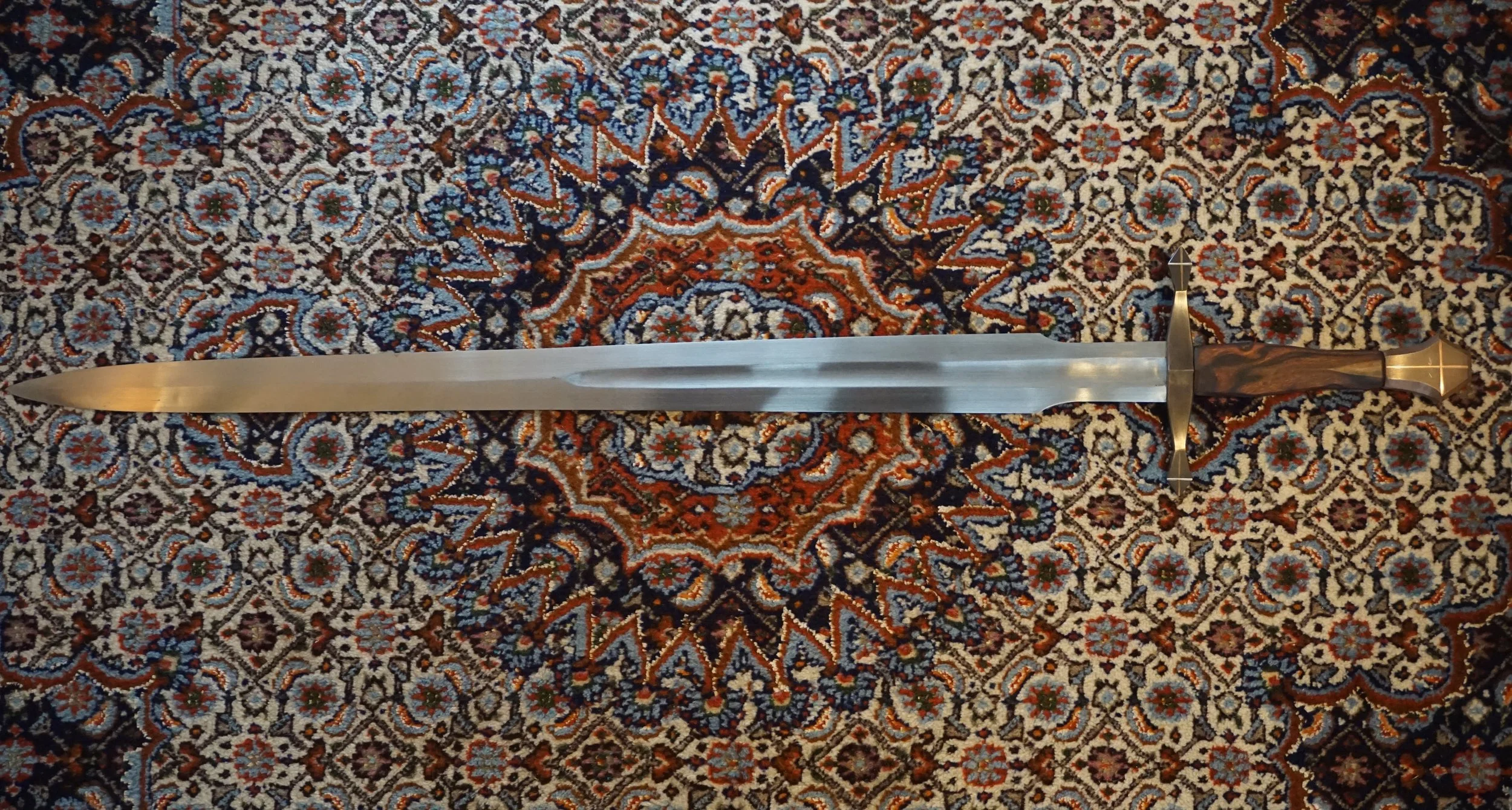
Will this sword empower the bearer to find the grail?
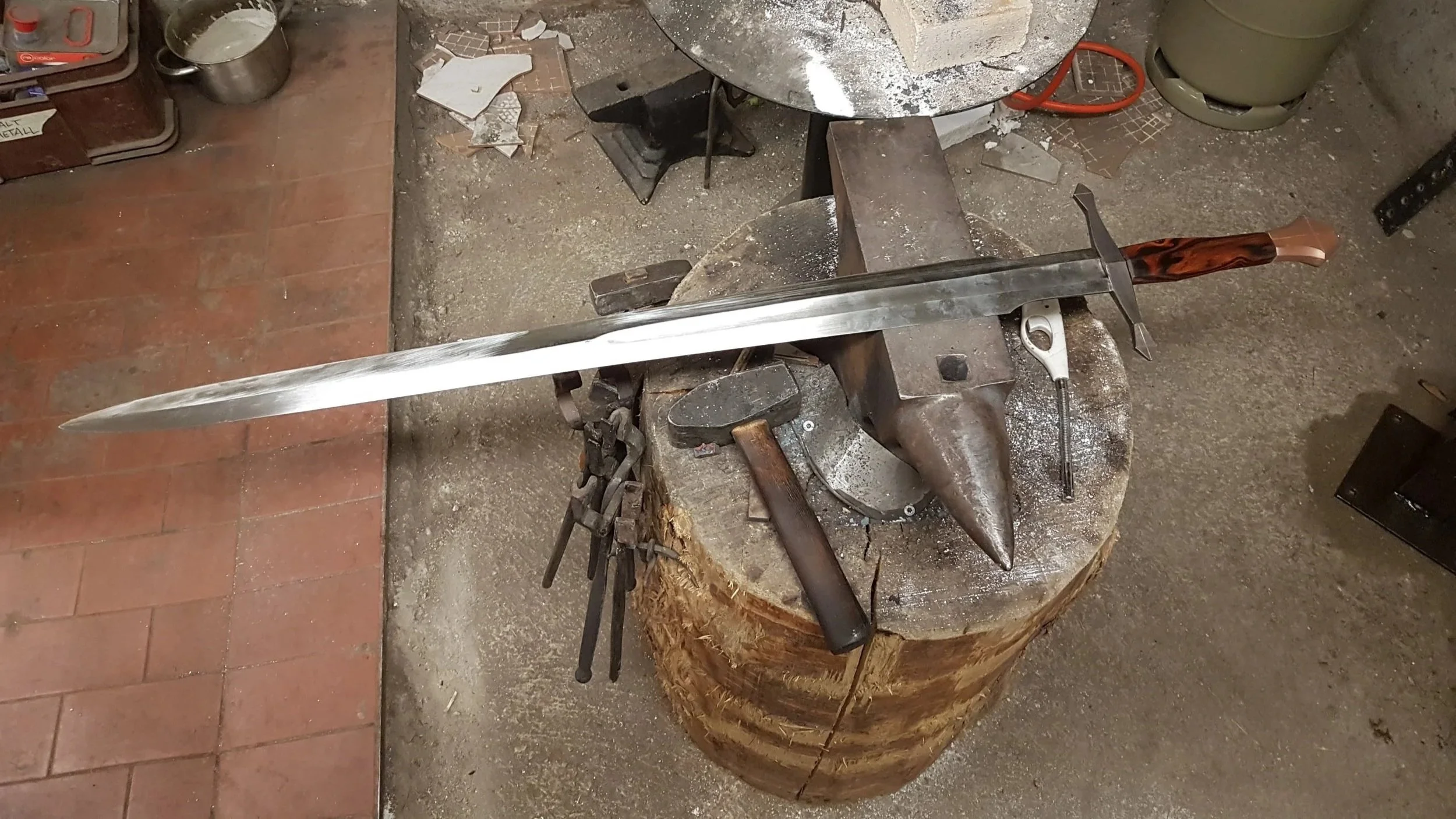
Fresh from the anvil.
The blade is made from 1075 carbon steel.
The hilt is assembled by a guard made of bronze, a pommel out of copper and kingswood for the handle.
The balance point is 12 cm behind the guard and the two centeres of percussion are where they are supposed to be.
In total the sword is one meter long with an 80cm blade coming in at around 1,2 kg.
Parzival has been my favorite tale for a while now and I’ve known it from childhood days.
I was revisiting the myth in the aftermath of a breakup that would end a seven year long relationship. After I finished reading the tale, I started on a project a little to big for my knifemaking workshop: A one-and-a-half-hander, a bastard sword. For a month the outside world vanished as I descended into the underworld of my forge. My fingers turned black as the parts got shinier and the chaos in my workshop increased as a functional structural organisation slowly took form in the shape of a sword. Then I emerged, ready to cut old things apart, ready to find my power, to go my own path. Ready to “parzival” -to pierce the valley.
This artefact has led me down many serendipitous events now for over a year.
It helped me start on a journey, I still dwell in and which illustrates beautifuly how Fateweaving can work:
First a meaningful event happens in life, in this case a breakup. To make sense of it, I channel my lived experience of the event into a piece of art. This allows me to not only see my experience more clearly, but by “wielding the art” I can adopt a specific stance towards reality. A stance that predisposes me to certain ways how I can interact with reality. In other words, the artefact serves to shape my salience landscape. More of what feels relevant can be seen and engaged with. By then interacting with the patterns I can now see, I get pulled along the story of life.
The patterns I encountered through forging and handling the sword, were of course heavily coloured by the Parzival story.
The tale is many things and very alive. I don’t want to trap and flesh it out to reveal a specific thing, because over my life it has been many things to me, but I want to share what kind of direction it pulled me down this time around.
Before I do that, I want to give a short retelling of the story. It will do injustice to the complexity and rich nuance of the whole.
For those who want to take a deep dive here is a beautifully illustrated version of the whole book:
https://ia800808.us.archive.org/22/items/storyofparzivalt00wolf/storyofparzivalt00wolf.pdf
Parzival:
Once upon a time there was a boy still in the womb of the white queen Herzeloyde. His great father Gachmuret died in a gruesome way fighting for honour in distant lands, a spear found its way into his visor killing him on the spot. Heartbroken, the queen fled with her son into the deep forest, hiding him from the deathly lure of knighthood and never revealing his true name. She only called him "beautiful face." But the boy's longing could not be held back, and one day, following an echo of that longing in the birdsong of the forest, he came to a clearing where three knights rode on magnificent horses. In his naivety he mistook them for angels. As he stood with glaring eyes in their path, the amused knights revealed who they were, and he ran home to tell his mother he wished to become a knight. Grieving, she gave him a donkey for a horse, a fool's cap for a helmet, and a boar spear for a lance, and pressed upon him a few counsels to carry in place of armor: greet all whom you meet, never cross a dark stream when a clear ford can be found, and take the teaching of any grey-haired man who offers it. In his eagerness to be off, he did not look back as he rode away, and so did not see his mother's heart break and die.
Riding through the forest, he came upon a woman cradling a dead knight in her arms, unable to let him go. He greeted her, as his mother had taught him, though he had no capacity yet to bear the weight of her grief. In the passing of a few words, she came to know whose son he was, and revealed to him his true name: Parzival, the one who pierces the valley.
He rode on until he met a Red Knight who had wronged Arthur's table, and thinking this the way of knights, Parzival slew him with his boar spear the same way his father died. In a gruesome sight he took the dead man's armor over his fool's clothes. Riding past Arthur's court in this borrowed steel, he passed an old lady, Cunneware, of whom it was prophesied that she would laugh only when the greatest knight of all alive came before her, and now she started laughing.
No sooner was he mounted on the horse of a better man than it carried him uncontrollably where it pleased, until it brought him to the hall of an old knight named Gurnemanz, who took pity on the strange sight of him. Gurnemanz taught him how to fight, how to speak and how to love. As he grew a little annoyed of the boy's endless questions, he at last told him: stop asking questions, and instead become the question.
He rode on and won a kingdom and a wife, Condwiramurs, by his sword. But the nameless longing was not yet stilled in him, and he left her to search for the mother he did not know was already dead.
His road led him to a hidden castle that could be found only by providence, never by will, where a wounded king named Anfortas sat beneath a wound that would not close, and a maiden carried past him a vessel of light called the Grail. His heart rose to ask: What ails thee my king? But he remembered Gurnemanz's word to not ask too many questions, and said nothing.
By morning the castle stood empty, as though no one had ever lived there. As he rode away, a voice shouted after him: You goose; you could have had it all, but you must have a heart of stone, to hold such a question back.
For years he rode alone and bitter, doubting God and doubting the Grail, until he came upon a hermit in the woods who was his mother's own brother. The hermit spoke to him of sin and grace and the wound the whole world carries, and slowly Parzival's confusion turned to sorrow, and his sorrow turned to understanding.
So, he found his way back to the hidden castle once more, and this time, when he saw the wounded king, he did not hold his tongue. My king, he asked, what ails thee?
And in the asking, the wound closed, the king rose healed from his throne, the wasted land beyond the castle walls broke into bloom, and the fool who had once ridden into the world on a donkey, became the keeper of the Grail.
In these times, I broke loose of my old life where it felt like I did not know my real name. I am a fool riding on the ideas of men greater than me. In peoples recognition of the force residing in my being, I hear the daunting laugh of Cunneware, leaving me confused what kind of destiny lays before me. I uncover places within and without that feel miraculously out of this world, so that I believe they can only be found by providence and not by will. There I am often left with fear to fail to ask the question. But every now and then, a great peace breaks through the clouds of my own self absorption, giving me tidings of a way of life filled with the fullness of the grail.
I hope Parzival, in form of the sword and the tale will help me to continually ride to new beginnings as a fool, so that I can become more and more my inner king.
