
Baldur -A knife to recover the light from the underworld
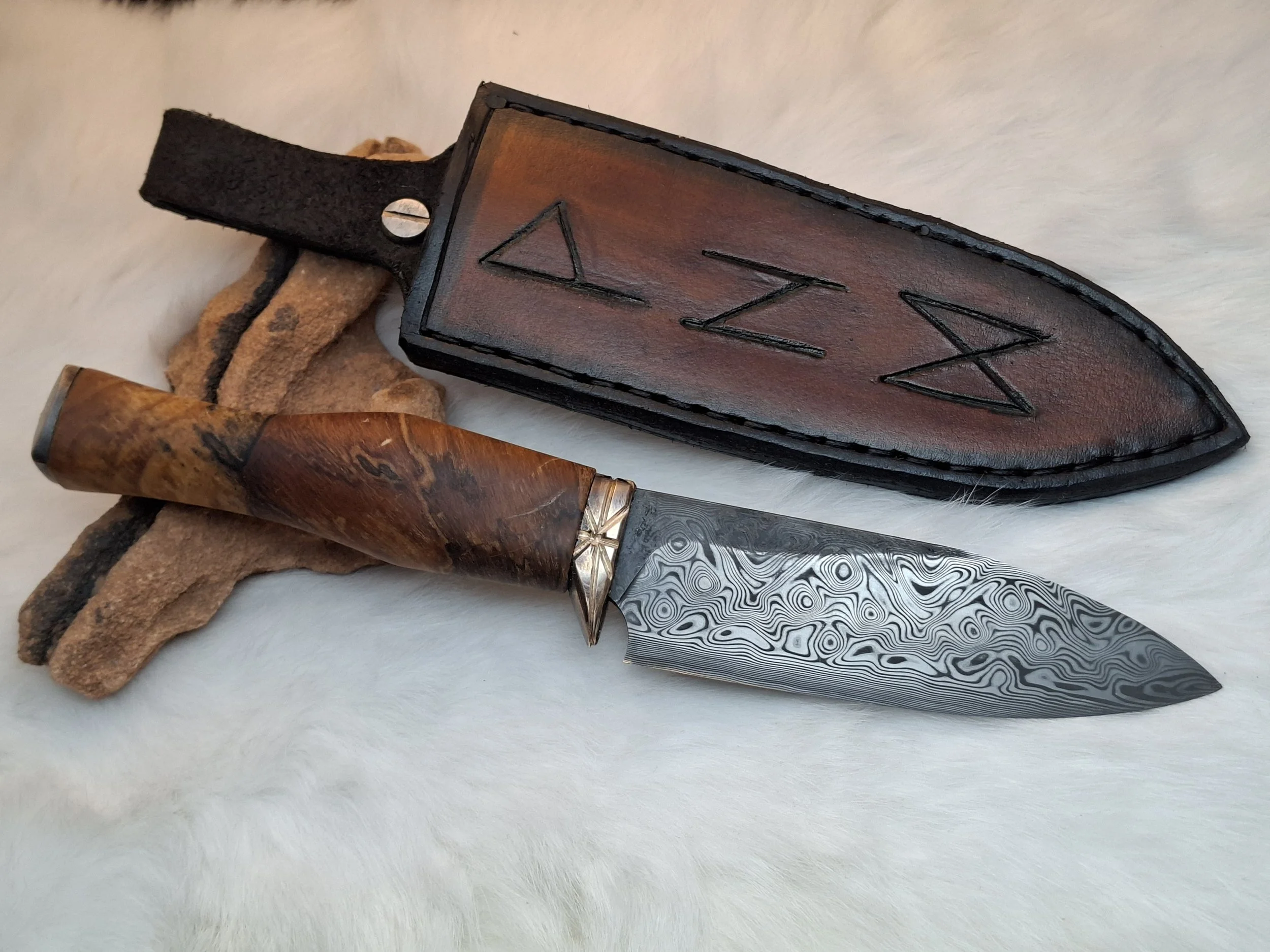
It is said that after the endtimes, Baldur will emerge again on a white horse to bring about a new order
A knife can be so much more than a tool for cutting things apart. The stile and quality of a knife can, if used intentionally, invocate a certain spirit with which the knife is used and carried.
This will be the knife accompaning me on my pilgrimage. I intend it to be a allie in practical and spiritual matters.
The knife carries symbolism from the Baldur myth, with which I want to illustrate the purpose of the pilgrimage.
The Baldur myth:
Baldur, the god of light and joy, was the most beloved among the gods. One day, he started having nightmares about his demise, which, of course, frightened the other gods -especially his mother, Frigg. So she set out to take an oath from all things and creatures in the nine worlds, ensuring that no one and nothing would harm Baldur.
When she returned from her journey, she witnessed a grotesque scene. The other gods were throwing blades, arrows, and other dangerous objects at Baldur, but nothing could harm him. During this spectacle, Loki, the god of trickery, approached Frigg and asked if she had truly spoken to every creature. Frigg replied, “Well, the mistletoe seemed so harmless that I did not ask it, for it surely would not harm anyone.”
So Loki took a piece of mistletoe and carved a spear from it. He handed it to Hodr, the blind god and Baldur’s brother, asking if he would like to participate in the raucous celebration of Baldur’s invulnerability. Loki helped Hodr aim. The spear flew, and to everyone’s horror, it struck Baldur, who fell dead on the spot.
They cremated Baldur on his ship, and in their great sadness, the gods placed his wife, the goddess of joy and peace, beside him, for she had died of grief. Odin laid his ring, Draupnir -the ring of eternal return and abundance- upon the pyre. Baldur then descended into the underworld, where a special seat awaited him next to Hel, the goddess of the underworld.
In an effort to retrieve the god of light and joy from the clutches of death, Hermod, one of Odin’s sons, ventured into the underworld to make a deal with Hel. She agreed to release Baldur if all creatures wept for him, and they all did, except for a giantess, who was Loki in disguise. Hermod only brought back Odins ring Draupnir, but Baldur had to remain in the underworld.
Now that light and joy were gone for good, a long winter held the world in its cold embrace.
It is prophesied that once Ragnarök, the great battle of the gods at the end of this age, is over, Baldur will return, riding a white horse and bringing a new order into a new age.
Myths are fractal in nature, reflected across many layers of reality. The Baldur myth, in particular, symbolizes the theme of eternal recurrence: the cycles of day and night, of summer and winter, of individual and civilizational flourishing and decline.
On a personal level, I identify my childhood self with the figure of Baldur. I was joyful and radiant, carrying a sense of invulnerability, as if nothing could harm me. But during my school years, some of that radiance was cast into the underworld, and adulthood shattered that illusion of invulnerability. After going through a personal meaning crisis Im now reemerging by trying to craft a new life on which my future self can stand. On a collective level, it feels as though we are living through a kind of Fimbulwinter, a long winter of the soul, what is often described as a meaning crisis. There is a growing sense, both personally and collectively, that this winter has run its course, and that it is time for the return of the god of light, for the emergence of a new order.
The idea of the pilgrimage presents itself as a kairos moment: an opportune time that must be seized. It carries the feeling that I might contribute, however modestly, to the alleviation of this meaning crisis.
The unfolding of this kairos is symbolized by the three sigils imprinted on the sheath:
The first is Wunjo: the experience of joy and temporary bliss—Baldur alive and at the height of his power.
The second is Hagalaz: disruption and great conflict—Baldur’s descent into the underworld.
The third is Dagaz: the new day—the return of Baldur and the emergence of a new order.
This sequence could be interpreted as a kind of personal eschatology, but I want to approach that idea with caution. It risks suggesting that one must hasten toward catastrophe in order to bring about renewal. The Nazis used the Hagalaz rune in exactly that sense, and I think we need not repeat what they did.
Instead, I frame the myth differently. The Baldur myth carries the motif of the ritual sacrifice of the king. In many traditions, the reigning king was sacrificed cyclically, as it was believed this act preserved the purity of divine energy, even as its human bearer faded. This was considered necessary because the kingly force was thought to be intimately bound to the land itself. The sacrifice allowed the land to move through its natural cycles, ensuring continued fertility and renewal. In the part of the myth where Baldur cannot be harmed, he appears invulnerable, yet he is already haunted by dreams of his own death. Before his power can become excessive or unbalanced, he is sacrificed.
In this sense, the myth is not understood as a personal eschatology, but as a reminder that becoming through transformation always entails sacrifice, and renewal is inseparable from loss. To cultivate trust in the cyclical nature of this process, I crafted a ring from the same steel as the blade of the knife and named it Draupnir. Odin’s ring is said to produce eight identical rings every nine days, symbolizing cyclical renewal and the abundance that arises from it. For me, it serves as a reminder not to give in to the Swabian impulse to hoard, may it be ideas or resources.
Lastly I the figure of Baldur had an appeal to me, because he is the son of Odin and Frigg, who are only two gods practising Seidr, a form of magic revolving around prophecy and the manipulation of fate. Carrying the offspring of gods who were engaged in “Fateweaving” seems quite fitting for my project.
The knife has already begun to evoke stories.
For years, I’ve been calling my workshop “the underworld,” as it was located in a cellar that was not particularly beautiful. During the crafting of the knife, I thought about ways to ritualize the act of emerging from the underworld with it: perhaps working through the night and stepping out with the first slivers of sunlight?
But on the day it was finished, I was exhausted and simply wanted to go home. But somehow, my legs carried me in a different direction than usual, and I ran into a woman with whom I had shared a beautiful connection, even though we had already said our goodbyes a week earlier (click here to read “The Cringe Is Dead S.85”). Instinctively, I pulled out the knife and unwrapped it in the middle of passing pedestrians. The first gaze to fall upon it came through the fascinated eyes of Ellie -a name composed of “god” and “light.” It was a worthy baptism for the knife.
Since then, I have been searching for mistletoe to incorporate into the symbol, expanding its meaning. A few weeks later, I found myself in a castle in France, surrounded by a mysterious forest with more mistletoe than I had ever seen before. The story from that part of the pilgrimage will come soon.
For now, I will leave you with a poem that captures both the myth and my stay in the castle.
The Sun
Imagine listening to a longing from beyond the rain,
from so deep you might have lost sight from where it came.
Slowly creeping like a vine,
it wound itself from within, to time.
A new time, a new dream that wishes to not be a dream anymore.
And then: I am.
The sun listens to its own heart beat spinning, ever faster, to a new beginning,
But longing turns into yearning:
It rises, it races to its might,
but if it burns to bright,
its love will turn to plight.
At the peak it blasts from everywhere,
burns with love -but only for itself.
It yearns with raging fire,
blinding all those that wanted to admire.
And then: I was.
It plunges back into the deep,
first blue then dark,
wanting to bury in shame
its just newfound spark.
Now the ashes of the world,
start to spread the word:
That a sun not seeing past its light,
knows not yet of its truest might:
That is by knowing it’s proper place and time,
it can help to make a new age shine.
That is to not turn everything into a blast,
but to shine on things to make them last.
And then: I will be again and again.
