
Morocco -Between Adventure and Prophecy
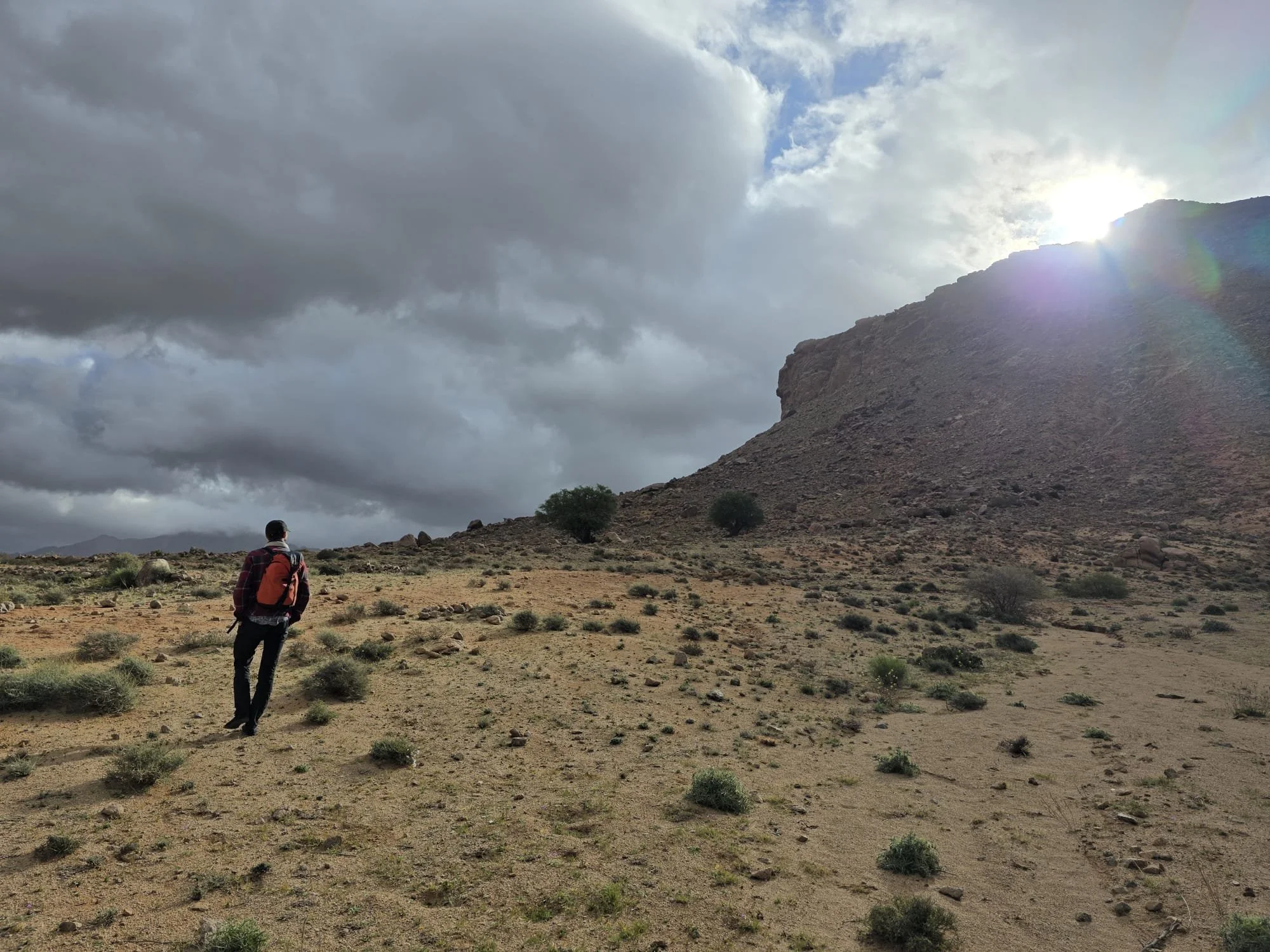
On our way to what would become the Centre of the Mandala
After the last stop on my Pilgrimage had provoked a new way in which I could relate to belonging in social contexts, my father invited me for a mountaineering trip into the desert.
First, we planned to go to the Wadi Rum desert in Jordan. We had been there two times already and were always fascinated by the fractal nature of its awe-commanding landscape.
This time I was excited to go there because in the context of my Pilgrimage, besides communities in which connection and stories dwelled, I also wanted to explore places in which old and powerful stories resided. The Wadi Rum desert got its name by the Bedouin tribes noticing that priests -Rum, Romans in their view- but really Jews and early Christians came to use the solitary caves in the desert as spiritual practice grounds. Now after spending time in the community in which life tends to flow in extroverted ways sometimes bordering on hedonism, a little bit of asceticism and lonely visions in some deserted caves seemed like an appropriate next stop.
After sinking into the landscape of this desert, the thought of a monotheistic God is almost obvious. Everything seems to be made of “One”; one mighty, harsh creator inspiriting the landscape with awe and wonder.
The Wadi Rum desert being in close proximity to ancient Mesopotamia with its rich messianic history, probably provided the soil or shall I say sand, for many prophetic visions, now encoded in scriptures that we used to fight and unite over.
Why do these stories have such an effect on us? For the last months that question never left me. I felt like the stories sensed my porosity and openness, swarming in from all angles to inspire and possess me. This presented itself in different ways, one of them would be that all of a sudden, all sorts of religions started pulling at me:
People would be sharing religious texts with me out of the blue, I got engaged in a series of dialogs with a woman who was in the process of starting her own religion. Also, I found myself going to church multiple times per week, not to listen to the sermon but just be in the presence of powerful symbols reminiscing about a past ruled by a shared sense of collective meaning.
But also, my dreams took on a religious, almost prophetic tone; in one I dreamt of a friend holding up a big frame with a painting of a bible cover, with big golden letters. It radiated a lot of meaning and I felt myself a bit dumbstruck like “should this really be it? Christianity, the bible as the answer?”
I wondered still in my dream, half in reverence half in disbelief, about all this searching and all these philosophical aerial stunts that I and my culture performed just to go back to Christianity? Then my friend ripped the painting off its frame, just to reveal another painting beneath it: a blue bird. It was the most beautiful thing I had ever seen; it was It, the answer to everything, the way forward, utmost goodness, truth and beauty united in one picture.
I try to not putting these encounters into categorical boxes, but still, I delight in relating to them, and letting them guide my way.
In this case a week before we wanted to depart, the Iran/US war had started and it was unclear if our flight would be cancelled and if Jordan would be safe to travel. We called with me still being in Feytopia, being a bit indecisive if we should still go or not. In the very moment my father mentioned the option that we could go to Morocco instead, a blue bird landed on the windowsill. Taking it as a gentle sign from the unseen hand, the decision was made in favour of Morocco, meaning in Arabic “the western kingdom” or “the land of the setting sun” and from the Berber word “Murakush” meaning “the Land of God”. These images carry enough longing in them, that I deemed them fitting for the Pilgrimage that after all stands under the star of “Arrows of Longing”, an image I first encountered in Nietzsche.
For him it stands for the people who are a bridge to something beyond themselves. I think at this point it is fitting to let him speak instead of me, in the tongue of Zarathustra:
Zarathustra, however, looked at the people and wondered. Then he spake thus:
Man is a rope stretched between the animal and the Superman — a rope over an abyss.
A dangerous crossing, a dangerous wayfaring, a dangerous looking-back, a dangerous trembling and halting.
What is great in man is that he is a bridge and not a goal: what is lovable in man is that he is an over-going and a down-going.
I love those that know not how to live except as down-goers, for they are the over-goers.
I love the great despisers, because they are the great adorers, and arrows of longing for the other shore.
The other shore…
I have always wondered about where the sun might go after it descends into the big blue of the Atlantic. There is an esoteric theory that the spirituality of the western mind can be encapsulated in a longing towards the destiny of consciousness, whereas the eastern mind longs to understand the origins of consciousness. Consciousness as the light rising out of the sea of our unconscious at the eastern point of the known world and plunging back into it at the most western point… at least until the western mind found the destiny of its longing in a new continent (for a while?).
I, even though having dabbled in eastern spiritual practice, was after all a sprout of the western mind, now about to find itself on the “land of the setting sun” reminiscing about yet to come destinies of the human soul.
Now sitting on the plane, I was bothered by the piece of advertisement screaming the death of culture and longing into my face. I slid it out of its bracket turned it around and started to write the antidote on it:
Flying
We have conquered the skies
but lost our admiration for them.
Cutting through the clouds with our machine birds,
our eyes cling desperately
to what they have been severed from:
The assurance that our longing for the otherworld
is not trapped behind thick walls of bony skull.
Our longing is also echoed in heaven’s longing
to be held in reverence again.
The clouds cry against the window.
As fingers from inside press against the glass.
And the pink skies reflect
a kingdom within us
yet unconquered.
Here we find ourselves
sleepy eyed, fighting to stay awake,
to witness the last slivers of a setting sun.
The light goes out, the engines’ roaring fades
and into the darkness a voice, so close yet far, whispers:
As without, so within.
Revel in the paradox, keep the tension,
for Soul and God are each other’s most intimate invention.
But this trip should not be just about reaching spiritual heights but also about grounding. After indulging in ethereal realms, time with my father can be a welcome reality check. Especially because we would not sit around in idleness, philosophizing about what ifs. Instead, we would follow my fathers’ arrow of longing which was to conquer as many mountains as his life would allow him to do so. This time he wanted to conquer more of them in the area around the mountain range of the Anti-Atlas.
In the first days I felt we were still coming out of such different worlds that we had some difficulties connecting. My mind always wanted to drag conversations into some airy-fairy philosophical domains, while my father seemed a bit lost and maybe concerned.
But soon mountaineering should not only be a bridge between us, but also between the spiritual and the grounded. The climbing in the area was of not too high technical difficulties, but protection in the form of bolts and anchors was mostly absent, lending the experience a sense of adventure. The hiking shared similar qualities in that the terrain was surprisingly accessible, which allowed us in turn, to venture deep into not often explored territory. The nature of the climbing and hiking lend itself well for long routes, in monotonous but pretty settings, where the mind could uncouple from the feet to go on a walk on its own. On the first hike I got into long ruminations about how I could share the experience of the Pilgrimage with others, thus leading me to the realisation that I want to offer a guided Pilgrimage in which people could walk through their own stories.
The second route was an alpine climb, with the fitting name of “Space Walk” on which my mind started to perform all sorts of acrobatics leaving me unable to write for a couple days.
On every trip my father looks out for THE Tour, an adventure worth dwelling upon, when one would be stuck again in the rat race of everyday life. We had been eyeballing with a mountain that deserved its name by towering above its surrounding summits: The Prophet Peak.
For obvious reasons it had a special attraction to me.
A long climb with the beautiful name Millennium ridge and 35 pitches drew our attention every time we pondered over the guidebook (one pitch is the length you can climb before having to set up the next anchor). The climb winds its way along a ridge, looking almost like a long scaly dragon’s tail, up to the promise of a higher perspective on the valley and maybe on life.
Climbing 35 pitches is a serious endeavour, depending on the difficulty a pitch can take between 10-40 minutes, so we were potentially looking at 12 hours of climbing without taking the descent into account.
After a day of rest, we embarked with high spirits but without dropping our attitude of not-knowing how the day would unfold. The local saying “Inshallah” -as God wills, always guided our outlook on the unpredictability of these adventures. Over many years this saying served us well, not as a fatalistic attitude, justifying reckless sensation seeking, but as a reminder to stay humble and well prepared in face of forces greater than us.
With that spirit in mind, my father had been scouting the day prior for the best approach and looked at the first couple of pitches to gauge the difficulty. He came to the conclusion that we could probably do much of the climb free solo -without the protection of a rope- which drastically increases the speed. Risk assessment in mountaineering depends on many different variables. Speed for example can of course give rise to more mistakes due to carelessness, but at the same time speed reduces exposure time in high-risk environments.
But this day everything aligned and we started climbing in surprisingly good rock in relatively easy technical difficulties without a rope.
Free solo climbing is temptingly freeing, without having to stop every couple of minutes to belay your partner to your level, the mind just dissolves in the fluency of the body fitting itself as an endless flow to the texture of the rock.
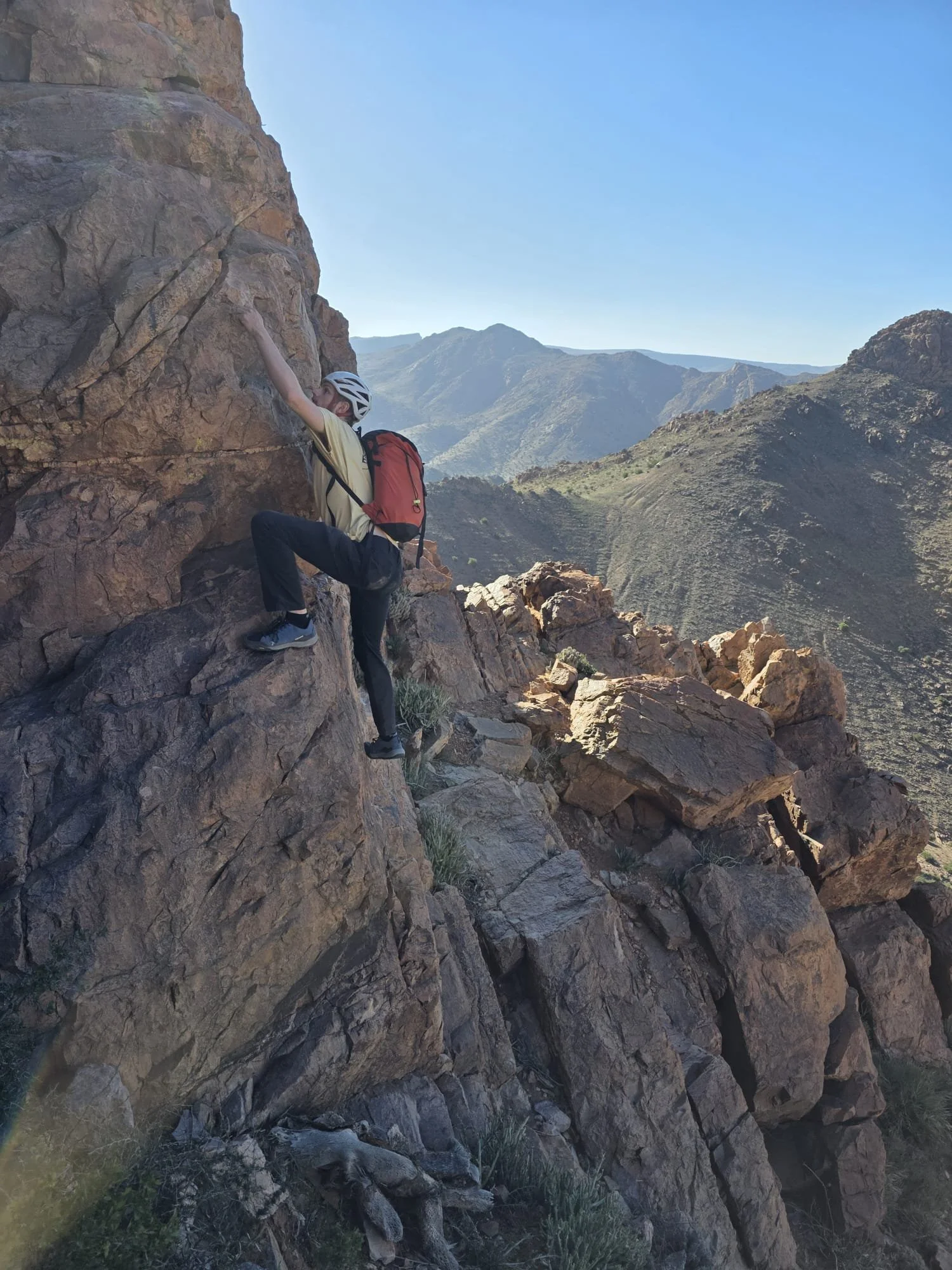
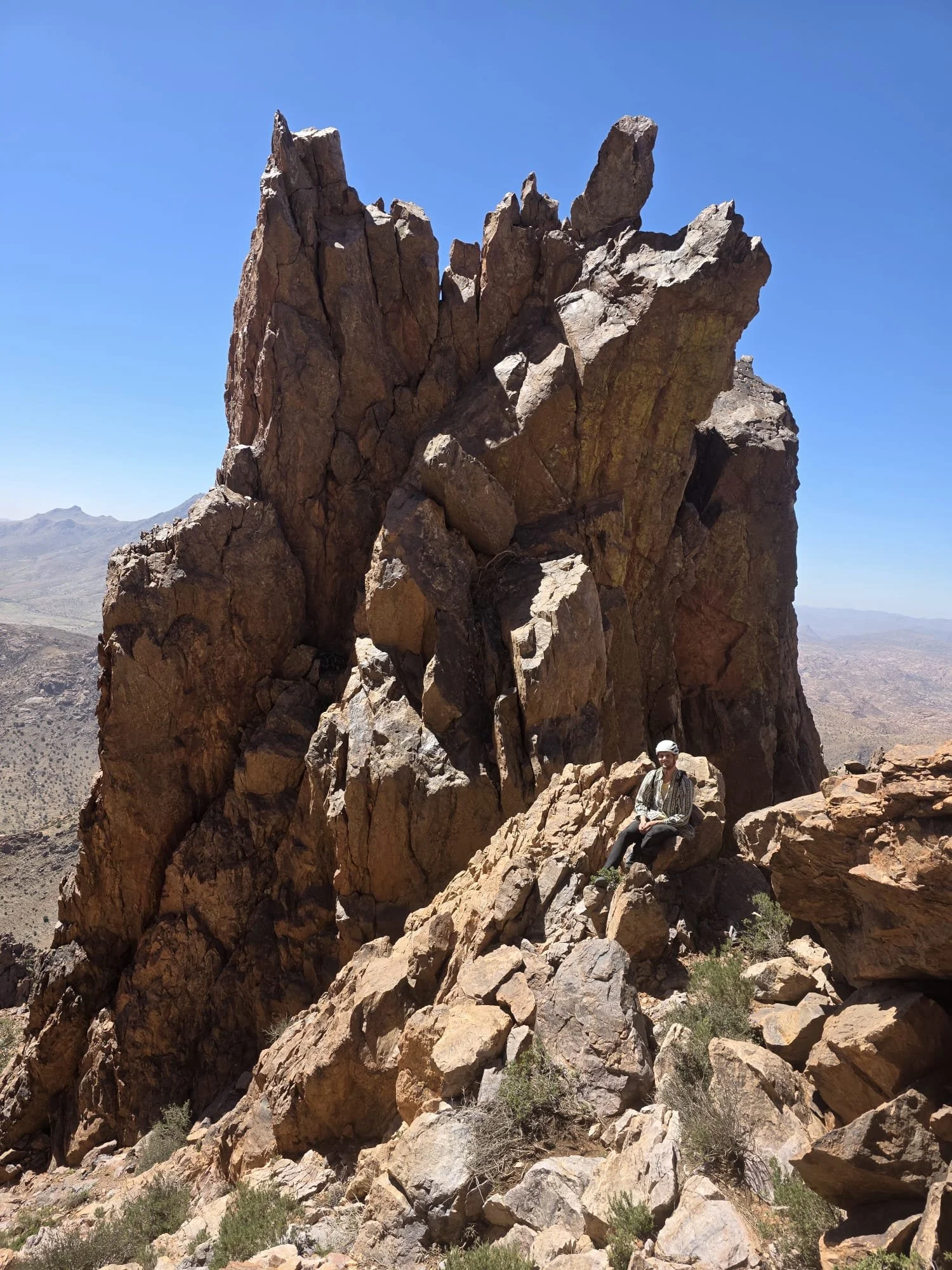
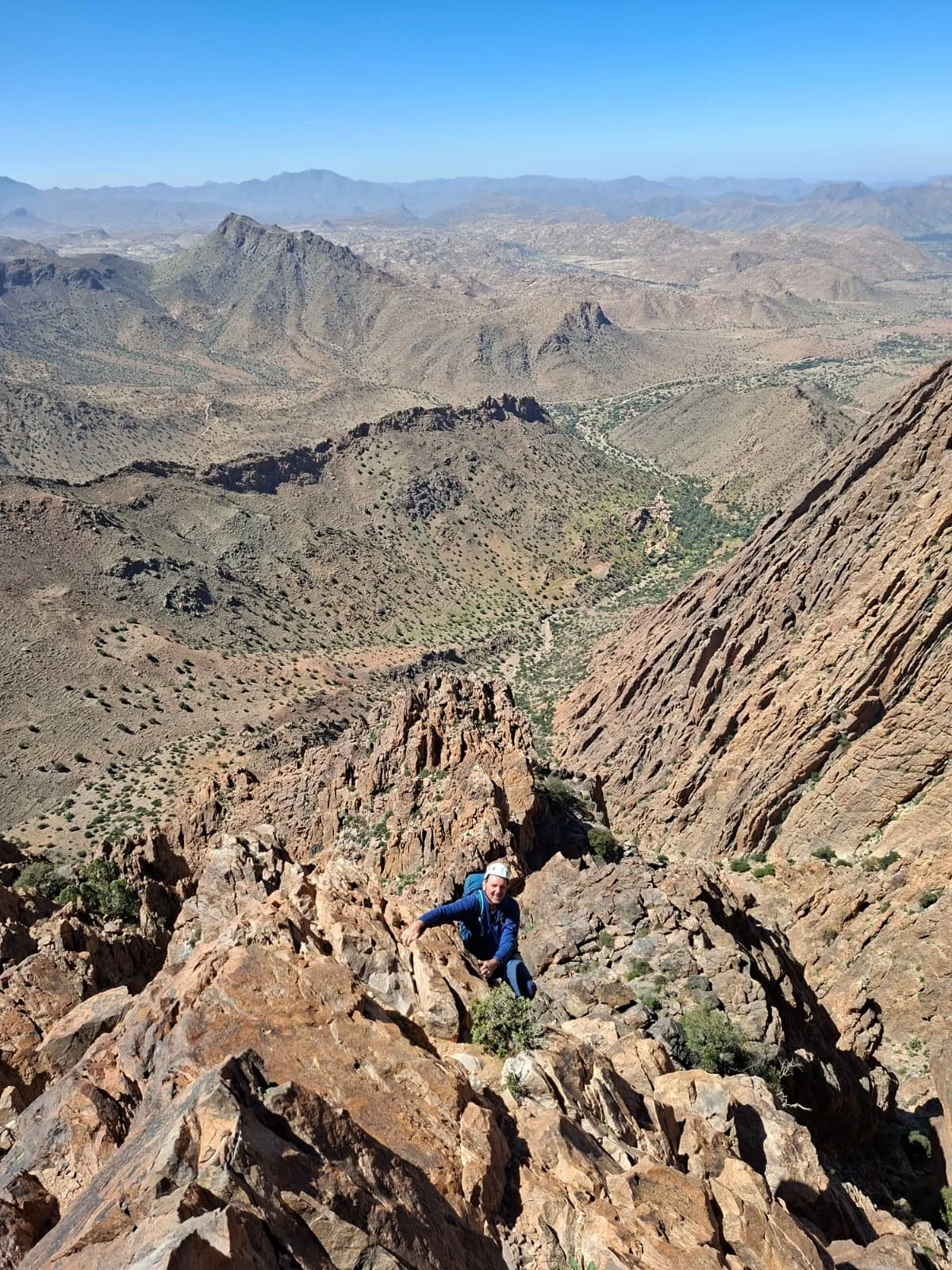
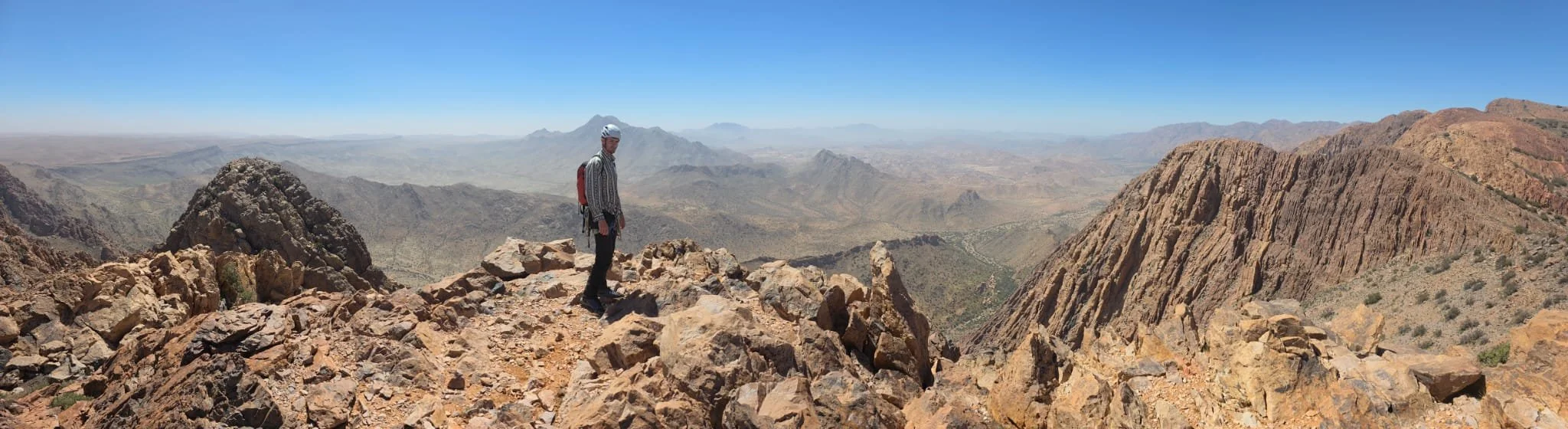
Looking down every now and then, I could not help myself but be proud of my father. He was now slowly approaching the 7th decade of his life, with his bones carrying memories of 50 years fighting against mountains in all shapes and forms. I’m not sure who the victor in these battles was after all, for as far as I am concerned, most of these mountains still stand and will stand long after we will be gone, but the way he is still pursuing and sharing this passion is a sight to behold.
Now after having cruised through the first 20 pitches in about two hours, we had a short break in the shadow of a spire we just abseiled down. According to my father the spire had the shape of a crown and he wanted to take a quick photo of me just under it. I felt it to be a cute and honouring gesture.
I think people need these small and continuous reminders that show them, on what stage in their development they find themselves. In my case, I took it to be a reminder, that it is now time to wear the crown of my own kingdom and to venture beyond my father’s kingdom.
In the context of my profession as an experiential educator I think a lot about what it means to be initiated, and I think the mountains can provide a perfect ground for initiation. In my case it was not one single route that served as the one big initiating moment, but it was more of a slow transition from following my father’s lead, to increasingly taking up the sharp end of the rope.
Even though I think transformation oftentimes occurs in jumps, through my parents I learned that small transformation watered by a constant dribble of love and encouragement can be the most honest and long lasting.
Even though I value the intensity and depth of meaning charged rituals and the transformations arising out of them, I see how slowly honest maturing, that does not need to prove itself with flamboyant fireworks of meaning, sometimes carries the most depth.
Many people are not fortunate to have parents who nurtured and encouraged them in small incremental steps. Also, parents like all humans have many faces, some of them nurturing and some of them repressing. This leaves us all with a lot of self-parenting left to do.
I believe that maturing entails, that we have the increasing opportunity and responsibility to adopt a kind of parental, agapic love as a way of life. A way of life unrestrained, as an overflowing fountain nurturing everything in its environment because that’s the truest expression of its nature.
Now I got pulled out of my thoughts by some final more difficult and exposed pitches, sweetening the appreciation for life in face of its ever-present, but now especially salient impermanence. Having mastered even that last bit with cautions enjoyment, we had conquered the Millennium ridge and stood on top of the Prophet Peak after just four hours of climbing mostly free solo.
Prophet peak -what a fitting name for this summit. To honour the name, we talked about the symbolism of the prophet in contrast to the figure of the hero.
While the archetype of the hero explores the underworld of his innermost individuality, the prophet ascends to the heights of shared collective meaning. Now we stood here with the Millennium ridge behind us and a new Millennium ahead of us.
What would come of it? Where would this seemingly increasing acceleration of our time lead humanity? With excited anticipation for an uncertain future, I shared the theory that humanity may be approaching a new threshold in the development of consciousness, one in which we enter into a new relationship with reality by becoming truly active participants in the shaping of culture, coauthors in the collective story of life, rather than being pulled along by the memetic forces of history.
While the hero risks falling into the darkness of his own abyss, the prophet risks getting absorbed into the light of our collective illusions. Both need to return back to the middle world of human affairs to truly accomplish their mission. With this in mind, we let our gaze float off one last time into the distant future and valley in front of us, before making our way to the descent, which statistically is the most dangerous part for most mountaineering activities. This would also prove to be true for this one.
For two and a half hours, treacherous steep slopes littered with stones small enough to be unstable, but big enough to pose a serious ankle-twisting risk, tied our spirit back from lofty realms, into the reality of feet balancing between suffering and impatience.
But then inshallah the car awaited us, with the promise of us being able to take a tiny speck of that spark we had found on top of the prophet peak to share with the world.
The coming days I felt the need to spend some time alone in my room, while my father took his endlessly restless bones for some alone time in the desert.
But then with the end of the trip coming ever closer we had talked about one last adventure that would make this trip honourable, at least in our books:
20 minutes from the small town we were staying at, was a mountain, not too tall with maybe 250 meters of elevation, but a very steep face, seeming daunting and inviting at the same time. There was no record in the guidebooks of any routes through there, and now after having some experience in the region we thought that a first ascent might be possible. So, we prepared our gear, drove off and soon walked up to the base of the cliff.
With uncharted territory in front of us, looking way steeper and more difficult than expected, our age gap expressed itself in different evaluations: My father feared that we might get ourselves in trouble and that it was not worth it, I on the other hand was eager to try. After some back and forth of pondering possible lines through the vertical labyrinth of stone, I wanted to give it a shot.
Over the years I had become an apt sport climber, which gave me a sense of confidence rooted in competence. My concerned father shared the trust in my ability but was also subject to the sorrow that sometimes likes to possess parents.
I climbed the first pitch and was surprised by the athletic quality of the climb; I managed to build an anchor and encouraged my father to come. He did and with that we soon found ourselves in front of another decision; if we should pursue the dream of this first ascent further or abseil down, now that the ground was still within easy reach.
I took the decision with an eagerness to explore the next pitch, which was a difficult traverse on awkward flakes. That game of slowly teasing our way in a careful but bold manner through the wall continued for a couple of pitches.
It is extremely exciting to climb into the unknown, truly not knowing if the ascent is possible or if the next pitch would prove to be unclimbable.
Climbing as renegotiating the relationship to the unknown can also be approached as a spiritual practice. I learned over the years and again on this climb that climbing oftentimes requires a lot of faith. But faith not as drawing unreasonable assumptions about my climbing partner or my ability, but as reasonable trust in something cultivated. Faith understood in this sense is not only providing a sense of security, but also rational decision-making acting as the proper ground from which to expand one’s boundaries.
After pitch four we reached a physical boundary, where the line we had envisioned dissolved into a sandy passage of balancy moves that could not be protected. Falling into a self-build anchor could lead to the whole party falling to their death. Carefully I climbed down again to my father and inshallah found another way shortly after that.
The finale of the route was a beautiful last pitch with athletic moves on good holds, leading to a perfect top-out where the vertical realm led straight back into the horizontal plane.
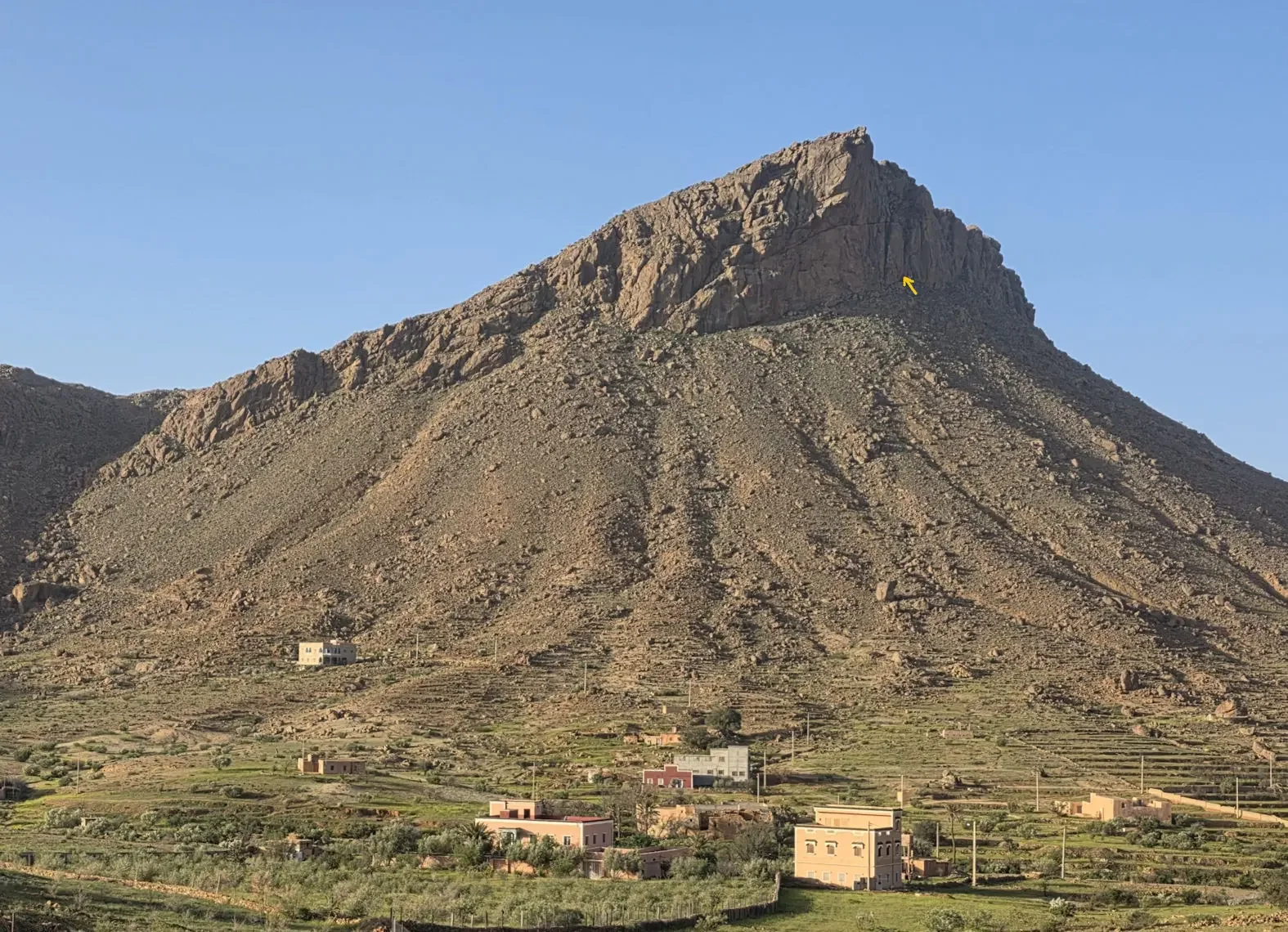
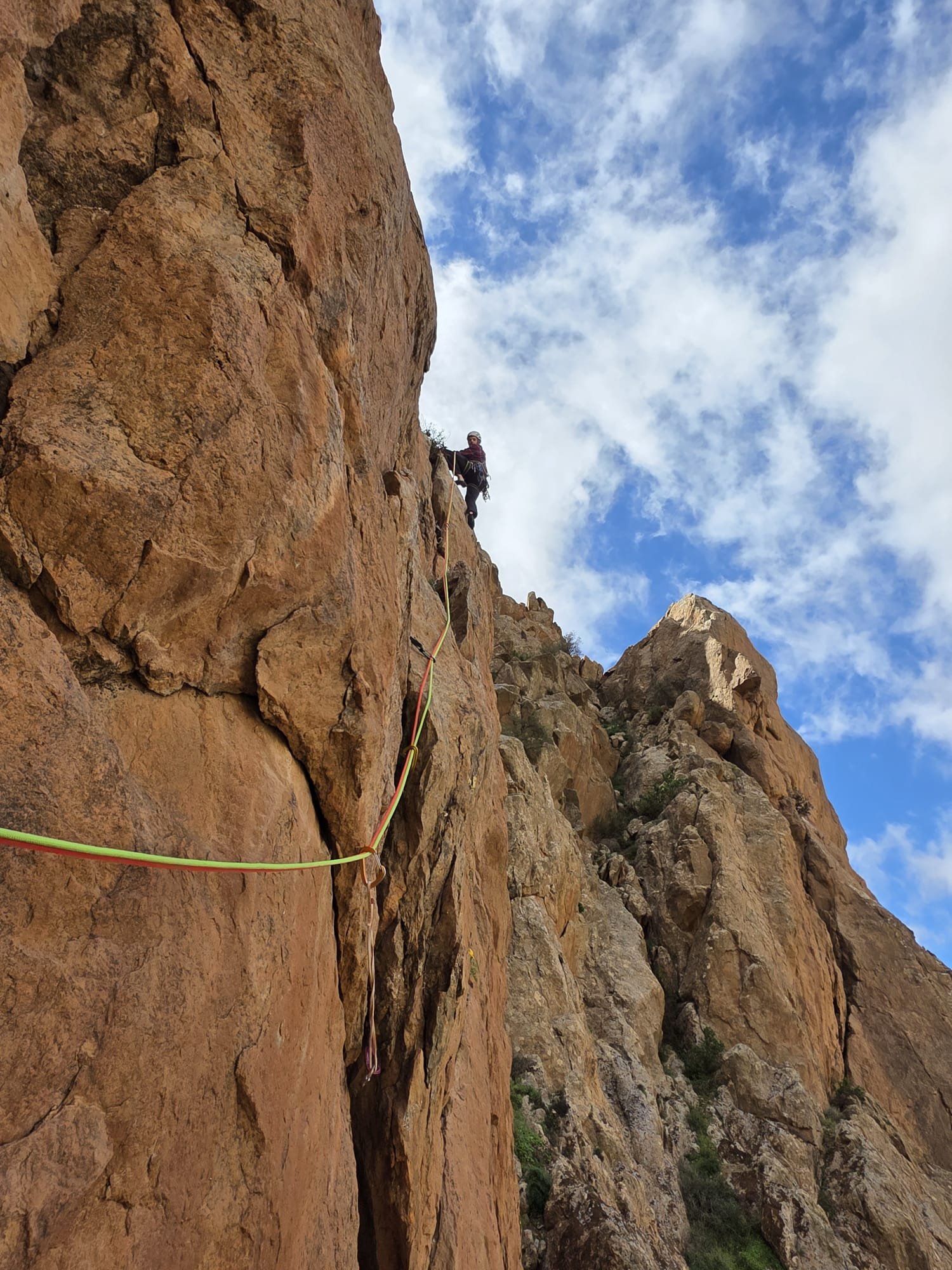
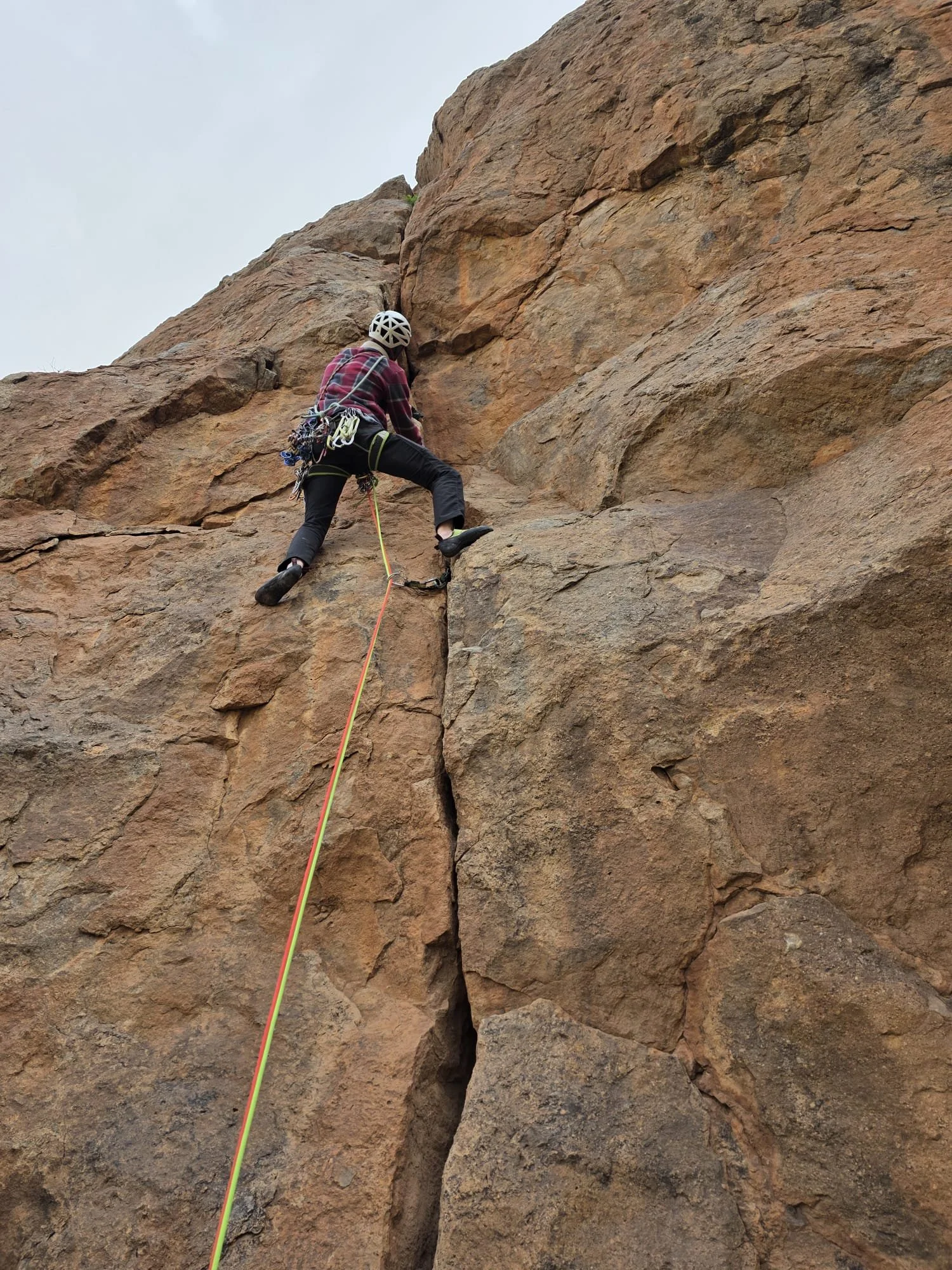
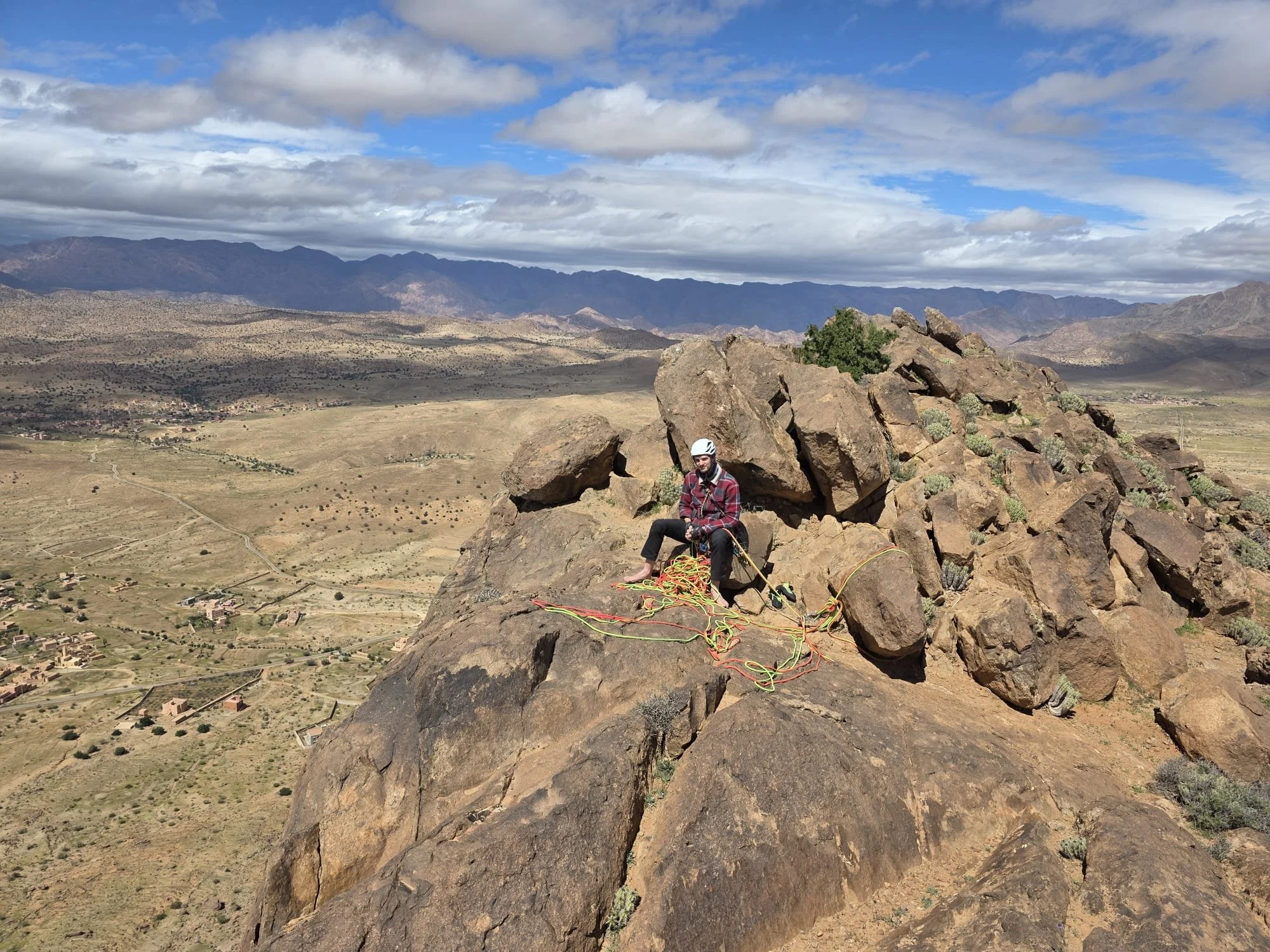
We ended up taking the same amount of time for five pitches as we did for the 35 pitches the other day. But we were blessed with difficult climbing through excellent virgin rock, and a first ascent on a new wall. We were proud of our achievement and my father especially of me.
On the way back we talked about how we would like to name this route, which led us into a deep dialog about a topic that was also a driving force behind my Pilgrimage: The feeling of being worthy or the lack thereof, encapsulated by the metaphor of standing in the centre of the mandala as an expression of coming into contact with the archetypal self.
For a long time, I had the feeling that I was not worthy enough to be. The inappropriateness of this feeling was validated by people noticing me not really presenting myself in a way that matched my abilities. They reflected back to me, that I would always diminish myself in some way and not show up as I truly was. They described it, as if a fatherly hand was resting on my shoulder holding me back.
To explore this pattern, I had developed a ritual every morning where I would ask myself; how I could live this day in a way that I would feel and become more worthy of “standing in the centre of the mandala”.
This of course was also a theme in the last stop in the Feytopia community. But now I had the opportunity to address this in a more grounded and intimate setting. For a while now I had the impulse, but not quite the courage, of asking my father if he would like to take a psychedelic plant medicine with me, in order to take a deeper look at this dynamic. But I had realised that these psychedelic explorations are not anymore of any interest to him. But the adventures during our desert trip, culminating in this first ascent, had opened up a similar depth of intimacy. To conclude our time together, but also my struggles with feeling worthy, we ended up naming the route “The Centre of the Mandala”.
Now with a fervour to spread my newfound agency in the world, my thought got carried away again to the distant shores of Nietzsche’s aphorism. Picturing the departure into a new way of life, the following poem flowed out of me:
Sailing
Staring into the oceans blue,
I start to write my life anew.
The tide begins to guide my hand,
as shifting futures form in sand.
Wind coming from distant shores,
sharpen my senses to old lores.
An urge arises to sink into the sea,
to lose that which I once called me.
But before my feet take a daring step,
I remember the tale of an old wreck.
A ship once so mighty, tall and swift,
forgot that depth can lure its keel adrift.
So, my gaze shift towards the sky,
it starts to wonder how and why:
How do we join the sun on its ascend?
Why do we long for the place of its descend?
Well questions cannot stop my soul from wailing,
answers only reach those bold enough for sailing!
Now I looked and wondered enough,
Now I must depart and sail aloft.
Trusting that my way lies between the deep and high,
I sail between the sea and sky as an answer to my why.
