
The Departure -Between Hearing and Heeding the Call
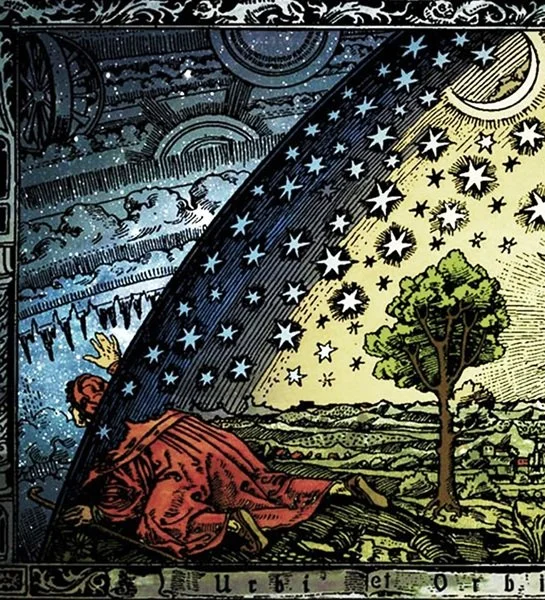
After the Garden and the Castle I felt like the character peaking beyond the firmament in Camille Flammarion's L'atmosphère : météorologie populaire.
The story of the Garden and the Castle wound itself back into city life. Flowers and laughter were swapped for grey streets and stale faces. In the myth of Parzival that had accompanied me for a while now, Parzival, after he had been cast out of the Grail Castle, failing to heal the Grail King, had to wander for many years before he had a second chance to enter the Grail Castle. I felt similar to this, having had an otherworldly experience loaded with meaning, but now left with confusion about what to do with all of this.
It became apparent to me that I can’t keep living on “the line,” a way of life that is fragmented and alienated from the story of life. The energies and agency that I had just found in the transformative experiences were strong, but trying to integrate them in the environment I was embedded in confronted me with a balancing act between inspiration and inflation. Also, the energies that had been unleashed did not have an adequate social context to express themselves in, so loneliness and everyday addiction started creeping slowly back in.
I knew I had to answer the call I heard; otherwise, the experiences would not be integrated, which would contort my psychological development.
So I decided to leave the city in search of what has symbolically expressed itself to me as “the white fountain”, a place where my life force can fully express itself by nurturing its environment. (Read the Garden -a firtile ground for the seed of fateweaving, for the whole story)
The departure ended up being bittersweet. I had a few months of trying to bring all my projects and relationships to a good end.
On one hand it felt tremendously liberating and exciting to leave a life behind in which I experienced a lot of alienation over the years, to embark on a quest that is highly aligned with my vision. On the other hand I build a lot of structures, that where, by that point, flourishing and promised to develop even further into something more coherent and beautiful.
I had build a knifemaking workshop, I cofounded a writing workshop, and a movement club in which we would organise movement festivals (https://bewegungslust-ev.com/). Also my work as a climbing instructor and experiential educator felt highly meaningful. But the way these things were fragmented from each other and the alienation I still felt in city life, made me follow what a friend described in a writing workshop as: Letting something go, in order for it to fall back into your lap somewhen else.
The following is an illustration of why I decided to leave my old way of life behind in order to go on a pilgrimage on the path of myth. With myth, I mean the stories that connect us by pointing us toward deep patterns within reality and therefore allowing us to gain orientation in life.
I want to frame the pilgrimage as a theoria -a sacred journey to test a theory of which I am part. It is an experiment, but not one where I am the supposedly distant observer; rather, the way I participate in the experiment will have a great effect on the result, and the process will have a great effect on me.
We will move from exploring about what makes hearing a calling difficult, to discuss what might help us to hear a call. Lastly we’ll reflect on how to interpret one’s calling in order to properly heed the call. It is an invitation to reflect upon your life by giving you insight into mine.
Hearing the call
A young person’s view on life is directed toward the future. The path that lies ahead is still greater than the path already gone. We long for a place where we can belong, and we search for ways to be worthy of that belonging. But it seems to me that in our culture we have confused being worthy with being able, and then being able with having a certificate.
This marks a shift in the way we existentially relate to the world. It is a shift from the being mode, to the having mode. Instead of being worthy to contribute to the story of life, it’s common to have a certificate and a job with which ones life can be supported.
Being worthy is not only being able, but expressing that ableness in a way that is morally sound and embedded into something greater that oneself.
Being able is also valuable, but it can lack the proper context in which a skill is performed. A skillful doctor with years of experience, treating his patients like products rather than humans, can be able, but not worthy of being called a physician.
A certificate, in the best case, is proof that one is able; but more often than not, especially now in the age of AI, it is merely recognition by the bureaucracy.
What could be our calling is now often our job. In my experience, a job is a necessity to make the rest of life possible, an exchange of resources in order to keep living.
A calling in contrast goes beyond mere survival. It is something you’d like to see in the world independent of yourself, it is the quest to make the world a more beautiful place.
To feel worthy again, I believe we need to relearn how to hear a call, provide places where people can hear their calling, and then create social networks that ground the calling through initiation, so that the calling ends up in service to the community. If a calling is the epiphany encountered in the mountains, the initiation grounds that into a wisdom in service to the village. How does your epiphany from the mountains end up being a village wisdom?
I think of initiation as a process in which the whole organism is primed in a way so that it knows how to stand and move within the spheres of personal, social, and spiritual life. It affords a deep relationship with reality itself; so that one’s identity is intimately bound up in the story of life. The story that emerges from this relationship can be an end in itself and thus be something greater than oneself.
I feel that in our era we slowly slide into adulthood. The stories and rituals that once gave us meaning by structuring our transitional phases and everyday life are slowly dying. This leaves us feeling like imposters, like personalities that were never initiated, stuck in the position of a mature person. Even if we are able, we are not sure whether we are worthy.
I have struggled for years to mature, and in my experience the institutions in my life, especially school and university, did not provide opportunities to mature in the ways I desired. In some cases, the institutions even hindered me.
The work after my education was different. By engaging in things that truly mattered: education in sports and experiential learning in my case, I learned and matured a great deal. I am grateful for that opportunity, but after a few years I still felt that something essential was missing.
To explain this, I will use the solar system as a metaphor for stages in the development of my psyche. It is of course, based on my personal experience, but I believe they could mirror, or at least rhyme with, the experience of our zeitgeist.
During my teens and early twenties, I identified with the planets and their orbits. They represented the different roles and personas I inhabited: student, athlete, lover, craftsman, friend. I would spend some time on one “planet” before moving to another. There were several of them, each with its own demands, fighting for attention. But there was no force harmonizing their movement, so I was staggering between them, constantly in danger of crashing one into another.
To stabilize this, my identity gradually shifted toward the sun. The witnessing “I” became a kind of gravitational centre. From there, the system gained coherence. The orbits aligned for a while, but the cost of that move was isolation.
Everything began to revolve around me. I had become the centre that held it all together, but also the only point from which I could relate to the world. And what is a planet compared to the might of the sun? The witnessing “I” became the only thing I could truly relate to anymore and even that, I did not know what it was or where it was. With that growing disorientation, the system slowly became turbulent again. There I was, lonely, and without orientation, carrying the strange burden of being the centre of my own world. I wished to extinguish the star, to not carry the burden anymore of being the center of my world.
Then slowly, it dawned on me that I was not the only star, that I might in fact be the whole solar system, and that there were other solar systems around me, whith whom I could form a constellation. But the way I was embedded in society made it impossible for me to connect as a whole system to other whole systems. Everywhere I went, I could only relate through a role.
Each role acted as an independent point of contact with the world. The only unifying factor that remained was myself. And life quickly becomes meaningless if everything revolves around oneself, so I entered a deep meaning crisis.
What I needed was a constellation of other solar systems, other whole beings, that could harmonize with mine, so that together we could orbit around a galaxy. The galaxy here represents collective meaning. But I, as everyone around me, remained caught orbiting around themselves.
With the strict separation of work, friends, personal interests, spiritual practice, romantic relationships, and family, a strong identification with the sun remained necessary to prevent the system from collapsing. Thus, I found myself in a dilemma: either becoming fragmented again by escaping on some planet, or unified under the tyranny of nihilism that arises through the rule of the ego.
In order to fulfil my desire to live a meaningful life, society seemed to offer two paths:
One option was to fully identify with a single persona: a planet aspiring to become a star. This meant putting everything into a career, becoming a professional athlete, or losing myself completely in romance or drug addiction. I tried and failed. It was not my path.
The other option was to continue balancing between fragmentation and selfcentered nihilism until I would start a family, which would then provide the new nucleus of my solar system. In this scenario, the I of the solar system would be replaced by the family as the gravitational center. But I felt that this would merely bypass the problem and hand it on to the next generation.
The desire to become more integrated led to a search for other approaches. The pilgrimage is that very search.
For now, I need to depart from the systems I don’t feel at home anymore in order to search for a binding element, a gravitational object larger than myself. To some degree, I have found it, or at least an intuition of where it might be, and that is story. More specifically, myth. I have come to see myth as something alive that acts as a binding element, stabilizing everything into harmonious orbits.
By engaging with the stories that have emerged in my own life, as well as the great stories that humanity has told throughout history, I slowly began to hear a calling that is growing ever clearer.
The calling I hear takes shape in a question: How can we create spaces where people can find their calling by re-membering their own story, embedded in the story of life.
Interpreting and heeding the call
Now I want to touch on how to interpret one’s calling in order to differentiate between inspiration and inflation. Because finding yourself within a Kairos moment can be intoxicating. It’s the feeling of an opportune moment when personal destiny and collective fate seem to be aligning.
A calling can trigger archetypal energies, patterns that have shaped human behaviours for millennia. These energies have tremendous power, which is good because they can be used to break out of the rigid homeostasis that is everyday life. But there is also a danger of getting swallowed up by these energies, if they are not contained and grounded in real life, with real constraints.
In recent months, this became very real for me. Through engaging in the practice of Fateweaving my dreams and visions began to take on a different quality, they were more symbolic, more charged, almost religious and prophetic in tone. I found myself a bit dumbstruck, not knowing what to make of them. Interpreting them literally would make me look like a fool. But explaining them away in a reductionistic manner would feel dismissive of personally meaningful experiences that, if acted upon could develop into something valuable for others.
Instead of falling into the temptation of chasing the question “what does it mean for me”, I began to relate to them, by bringing them into conversations, translating them into poems and giving workshops on what I believed I had found. By treating these experiences as something that wanted expression, they remained alive but still grounded in reality.
The aforementioned archetypal energies can be evoked through various means. That is hearing the call, heeding the call now consists of knowing how to interpret them and relating to them in a rational way.
Carl Jung expressed this dynamic beautifully in “the Archetypes and the Collective Unconscious”:
“Conscious and unconscious do not make a whole when one of them is suppressed and injured by the other. If they must contend, let it at least be a fair fight with equal rights on both sides. Both are aspects of life. Consciousness should defend its reason and protect itself, and the chaotic life of the unconscious should be given the chance of having its way too—as much of it as we can stand. This means open conflict and open collaboration at once. That, evidently, is the way human life should be. It is the old game of hammer and anvil: between them the patient iron is forged into an indestructible whole, an “individual.”
A calling, in this sense, is not a fixed fate. It is an ongoing dialogue between oneself, the unconscious and the world, requiring openness, discernment and experimentation.
This project is an attempt to make my process transparent, to bring what is abstract and elusive into something that can be lived and shared.
For me, approaching it as an experiment has been crucial.
The pilgrimage, then, is not an escape from life as it was, but a way of testing whether a different way of being in relationship to it is possible. I do not yet know where it leads.
But now I know this much: a calling is not something that appears fully formed and demands obedience. It is something that emerges through engagement, that clarifies itself as it is lived.
And perhaps the task is not to find it once and for all, but to learn how to stay in relationship with it, without collapsing into certainty, and without turning away from it altogether. If that is the case, hearing and heeding the call is not a single event, but an ongoing process: learning how to listen, how to respond, and how to take one’s place within a story that is larger than oneself.
With that I will leave you with two poems:
The Eternal Return
Eight corners, four walls,
locked doors, empty halls.
life watches me start spinning,
around questions of a new beginning.
loud silence, swirling thoughts,
buzzing noise, hungry ghosts.
Oh, what a despicable and endless hell,
to be addicted to that wretched pleasure bell.
Thank God for still letting me feel pain,
else I'd still be stuck in that endless plain.
In the flatlands of the never longing,
in the horrors of the always moaning.
But one day I managed to escape,
by taking death onto a date!
He whispered something in my ear,
a truth that soon became most dear:
Live your life as if you had to live it again!
What a horror, oh what a pain!
But it stopped me from living life in vain.
Goodbye
I’m sorry for I have left you.
I’m sorry for I will leave you.
I’ve been treading these streets for way too long.
I’ve been staring at these faces for way too long.
I don’t know what to tell you anymore.
I don’t know how to judge you anymore.
For you are everything but still all the same.
For you are nothing but still all too lame.
I must go searching for that which cannot be found.
I must go find what can only be beneath the ground.
Maybe I will come back and share my gifts.
Maybe I will not return and cherish our rift.
I’m delighted to see in you a seed.
I sense a blooming of our creed.
My only hope is for your spirit not to become stale.
My last spell will be a firm handshake before our vale.
Gone are the days of waiting.
Here are the days of walking!
TOWARDS A FUTURE NOT BOUND BY THE LINE!
TOWARDS A FUTURE INBETWEEN THINE AND MINE!
