
Fateweaving -a practice to regain existential agency
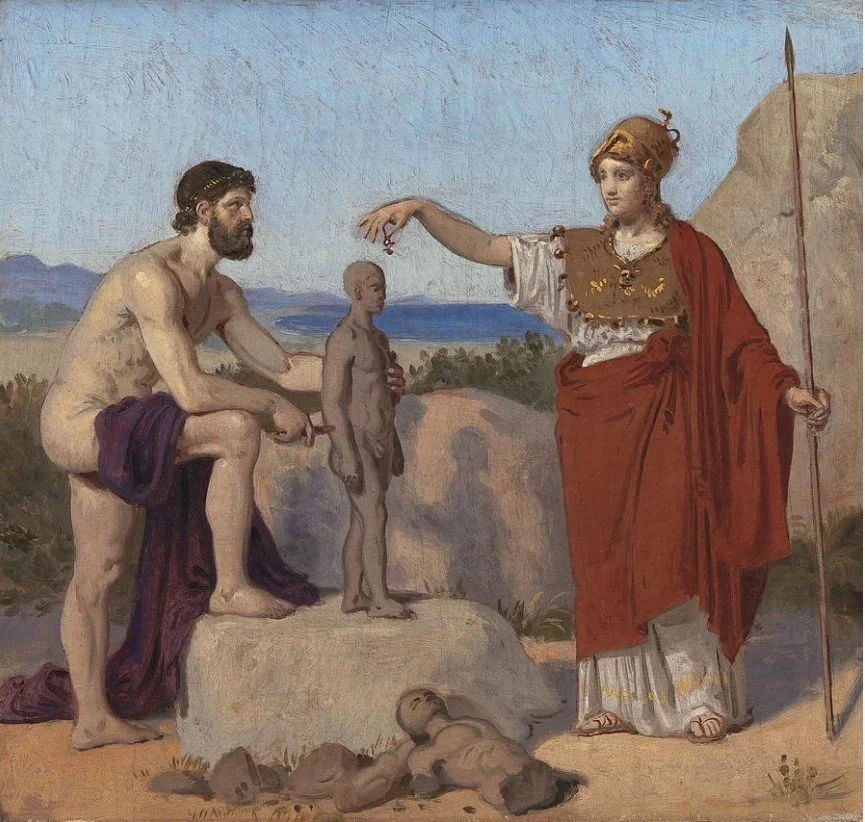
-Constantin Hansen 1845
Prometheus, the spirit of forethought, shapes man from clay. Epimetheus, his brother embodying hindsight, is tasked with granting each creature its essence, yet forgets to bestow one upon man. In response, Athena breathes psyche into him, a word that in ancient Greek means both “breath” and “butterfly.” Thus, the essence of man becomes the living spirit itself: ever-changing, unfolding through endless metamorphosis.
The prophecy
No one: “Can you re-member the prophecy?”
Someone: “Which one?”
No one: ”The one you are about to write.”
Someone: “But how can I weave that which I do not believe?”
No one: “You need the following artefacts: The fibers of your past, a spindle, an arrow and a bow.
By using the spindle, you can unite the fibers of your past into a string. Use that to pull the opposite ends of your bow into tension.
Then propelled by the tension between longing and faith, destiny and fate,
your arrow will hit into the heart of the unknown. The echo of its impact shall guide your way through the web.”
1. What is Fateweaving?
Fateweaving aims to weave together fate and destiny. Fate could be described, in Whitehead’s terms, as the initial aim out of God’s primordial nature. It grades and values each potential before that is actualised through destiny into a definite form. Destiny is the realm of subjective becoming, where one can concretise the potential into actuality through the creative act. Fate in “Fateweaving” is the part that attracts destiny. Weaving in “Fateweaving” is the active part so that we can become destined to our fate.
It is the attempt of synthesising the things that happen to us and the things we can make happen. When the synthesis is successful, we can move towards the future while getting pulled in by it at the same time, instead of just being doomed to our fate or crushed by the weight of our destiny.
Fateweaving is a psychotechnology of creative expression, specifically working with stories, through which we can co-create our future in relationship with the world.
By reciprocally opening to the narrative, relational, and imaginal dimensions of reality we can remember the story of our lives, instead of following a script dictated by the unconscious or by our culture. Through the creation of a personal myth, we can take ownership of our worldviews, and thus of how we relate to the world.
Fateweaving works by entering into a dynamic relationship with our personal story, that stretches across time from the past over the present into the future. The dynamism is marked by a constant flux of deconstructing and constructing, deciding and opening up, disidentifying and identifying with story. By using the tension in our stories as an existential propellant, we can launch our being into widening possibility spaces out of which the future can arise organically.
The story acts as a mirror that reflects our relationship to the world, as a lens through which we see it, and as a playground to embody what we envisioned through our imagination.
By creating a myth out of our past, living and interacting through that myth in the present and inviting the future through the imaginal, we can turn our story into a prophecy: written in the past, relevant in the present, and about to happen in the future. The imaginal here is not about make-believe or building illusionary fantasy worlds, but about enacting transformation -creating an imago, a mirror image of the self in becoming, close to what Jung meant by individuation: becoming who one already potentially is.
For prophecy to work, we must embody our story and embed it in the world. This happens by embodying key moments through consciously designing rituals.
To summarize:
A story acts as a mediating element between self and the world, both can join in writing the story, which then in turn can be the ground for meaning to arise.
The fateweaving process encodes our story into myth and thereby makes it symbolically accessible to us. Perceiving the world through that myth makes one susceptible to relevant patterns, because one perceives the world through a distillate of oneself.
Embodying and enacting that myth in a ritual widens it into a prophecy, which could be defined as a poetic call to action.
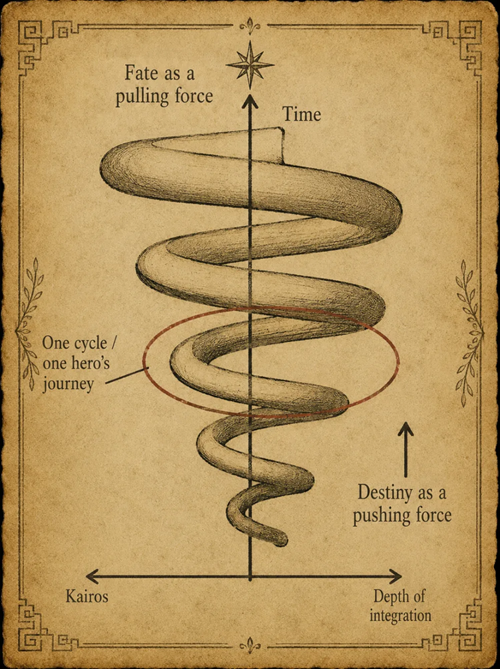
The fateweaving process unfolds cyclically, or more precisely, in a spiralling motion.
The cyclical nature comes from following the structure of the monomyth, commonly known as the hero's journey. The hero's journey is an adolescent mythic structure that shaped much of our culture for centuries. It is a powerful mythic structure, but now I feel we are called towards a more mature version. What matters here is not the protagonist, but the cycle of severance, threshold, and return. the vocabulary I first encountered through the mythologist Martin Shaw, whose own work traces it back further, into the older anthropological structure of separation, liminality, and incorporation.
One is severed from the ordinary world, crosses the threshold into the otherworld, just to return to the village with a gift.
The profane world is our biographical story playing in the realm of Kronos. Past, present and future form a line, ruled by the god of linear time.
The severance occurs when the current narrative giving orientation in our lives gets challenged by friction with the unknown. The model of our small world representation crumbles in the face of the large world with its infinite variables. The philosopher John Vervaeke argues that we move between these two worlds, through relevance realisation. I want to define story as playing in the large world and narrative as the small world representation.
By crossing the threshold, we enter the imaginal, a high strangeness and novelty environment, governed by Aeon, the god of eternal, unbounded cyclical time. This realm follows the laws of story based on the atemporal causality of meaning.
Here faith in the Good, the True and the Beautiful acts as a north star, while magic and synchronicities become friends and guides.
There is a third God of time: Kairos, the god of the opportune moment. He is depicted with a lock of hair growing from his forehead: you can only seize him as he runs toward you, and once he has passed, there is nothing left to grasp. When one encounters Kairos one's path completely merges with the story; one is overcome with the feeling that personal destiny aligns with the fate of the world.
In the otherworld one is challenged to surrender the old model of reality. By rising to the challenge through the development of a new model, one can return to the ordinary world with a gift: a story that can be shared with others, allowing the village to adapt to developmental pressures.
It is possible to get stuck in the threshold, where one can feel existentially homeless and torn apart by the urgency Kairos carries. When staying in the otherworld for too long, one can overidentify with the archetypal realm too much, which can lead to getting inflated or possessed rather than inspirited. When that happens, agency can be taken from us by parasitic cognitive processes that pull you down a spiral of maladaptive, self-reinforcing patterns.
Finding ways to disidentify with the story and come back into the profane world is important.
But one also has to reckon with the fact that during this process, phases of existential confusion are often part of the process.
The deeper the integration from the last cycle is, the more strangeness and disruption by crossing the threshold one can contain. Each integration cycle deepens one's capacity as a vessel for the unknown; each Kairos moment fills the vessel up with the possibility to actualize the potential of our lives. Integration happens by solidifying the story by weaving it into everyday life through practice and service for the community.
Fateweaving uses an ecology of practices navigating these cycles and different time realms. Through different techniques like active imagination, dream work, creative crafts, mindfulness and ritual, one seriously plays with enacting transformation in the imaginal and embodying it in the ordinary.
I believe multiple cycles can unfold simultaneously; there is the big cycle of one's whole life from the cradle to the tomb. There are also smaller cycles stacked on top of that, like the maturation from adolescence into adulthood or a midlife crisis. Even a single day's adventure can represent one cycle of diving into the otherworld and integrating that experience back with consensus reality.
These could be represented as smaller spirals winding around the one depicted in the graph.
The spiral moves towards an increasing disclosure with reality. Vervaeke speaks of love as mutually accelerating disclosure. Fateweaving could therefore also be understood as trying to fall in love with the world again, by a reciprocal opening between story, life and self.
Art creates more actual world and more ways of seeing the world at the same time. The artist and the world, both informing and transforming each other, start to rhyme with each other increasingly; at times the duality between the artist and the art, or the storyteller and the story, can dissolve. The Greeks used to call this process anagoge: when self and world open up towards each other, striving towards unity. In this case art or the story is understood as the spirit that mediates between them.
Under this light, a definition of Fateweaving could be: reciprocally opening towards reality through creating and embodying art.
Like a seed that contains the tree it will become, our story already holds the shape of our fate and destiny. Fateweaving shines light on the seed of our story and pulls it up the spiral, towards the light of time.
2. The meaning crisis
Confusion
Things are fused that should be apart,
things are apart of which I should be part.
My life still is a line and that way to straight,
when a story should be my fate.
Ethereal grasping but my fingers slip,
a spell almost but never leaving my lips.
The self in panic, claws on to thin air,
kills the dream and births a nightmare:
Dead matter trapped in the vast spaces between body and mind.
Where can I recover that which I couldn't find?
Where is the bomb and where is the fuse,
to burst open the cage of my muse?
There is a legend, that in Descartes' early years in a military campaign, he had a dream in which an angel appeared and told him that: "The conquest of nature is to be achieved through number and measure".
Later he developed substance dualism, which would become one more steppingstone in the history of philosophical development, that would make it increasingly difficult for us to conceive of an interaction between mind and matter. They were now conceived as two distinct substances, separating fact from value, meaning from truth, self from world, religion from science, mind from body.
The way we talk and frame our reality shapes the way we live in it. Our cultural grammar today is soaked with dichotomies -dualisms, that block us from framing reality in a holistic way. So often we find ourselves not able to come into contact with ourselves, each other and the cosmos.
The philosopher John Vervaeke calls our cultural condition the meaning crisis. It names the sense of disconnection, insignificance, and purposelessness that so many feel in the (post)modern world. This is a complex phenomenon, interwoven, recursive, and systemic.
This whole section is heavily influenced by his thinking. I highly recommend watching or reading his Youtube series "Awakening from the meaning crisis" or his book with the same name.
What follows is not a comprehensive map, it is a way of situating fateweaving in relation to the crisis and showing how it could help us step into a living relationship with meaning again.
How a story can help us to realize meaning:
The goal of this paragraph is to work out what meaning is and why we can't realize it with our cultural framing of reality.
To realize something is not only to understand it, but to make it real through participation. It's a change that changes the one who becomes aware. Meaning, therefore, cannot be something observed from a distance. It must be enacted and embodied.
To address that, we need what Vervaeke calls a return to contact epistemologies.
Contact epistemology is knowing through participation. Instead of assuming propositional facts about the subject of interest, one embraces what it means to be intimately interwoven with what is of interest. Here it is interesting to note, that the word interest comes from the Latin "interesse" which translates as being in-between. A contact epistemology describes how we can know from being in-between.
I propose that story could provide the ground for organic meaning realization through anchoring meaning in the dynamic relationship of self and world and not search it within either the subjective, or objective realm, but what Vervaeke coined the "transjective". The interface to reality, the space between that emerges by the constraints of the structures we are embedded in and the degrees of freedom our agency provides.
As an illustration I will appropriate the myth of prometheus, epimetheus and athene as a symbolic reading for what meaning realisation is really about.
Our culture oscillates between reducing meaning to mechanism or dissolving it into interpretation. On one side stands materialistic rationalism, which locates truth in the objective world, on the other stands idealistic romanticism, which locates truth in the structures of mind. We might be drawn towards one of those philosophical viewpoints but they both act as the shadow of the other one. One framing implicitly includes the other even though they seem to explicitly to exclude one another.
Because relying on tradition and metaphysics don't seem tenable anymore in a world in which metaphysical certainties collapse, the belief arises, that only measurable, scientific knowledge counts. This leads to a worldview in which we feel increasingly alienated from the world we live in, because our subjective experience is not accounted for. In protest against the view that the universe is a machine governed by law, romantic idealism says that meaning arises only from interpretation, that it is our minds giving shape to our world.
Materialistic rationalism cannot eliminate the subject who interprets matter; romantic idealism cannot eliminate the resistance of a world that pushes back.
Both carry a hidden limitation, because if truth lies only in matter, then meaning becomes an accidental byproduct of blind processes. If truth lies only in mind, then meaning becomes a projection onto an otherwise lifeless world.
Because the objective truth materialism searches for is never reachable, the culture overcompensates for that realization with romanticism which collapses truth into the subjective.
Because subjective truth remains ever relative, the search for "objective" truth will be cloaked in hybris, because the subject searching for objectivity tries to cover up the fact that it is only a subject.
Both framings block us from being able to get into contact with reality.
So we are stuck with the burden of meaning making falling entirely on our isolated selves, while still being unable to connect to something else alive than our own. I feel like at the moment we are feeling both like a cog in a machine and like a lonely tyrant trapped in a hall of mirrors.
Postmodern relativism sharpened the fracture. If everything is "relative" in an objective sense, then no truth claims can stand, or all can, depending on who speaks.
The fracture we feel in the world of ideas, the noosphere, influences our social sphere and our infrastructure. So, for many, life in the 21st century looks like wandering through crowded cities, while loneliness trails them; with neither gods above nor stable ground below.
Now I'd like to give a symbolic reinterpretation of the myth of the animation of man by Athena in order to give an impression of what meaning realization is really about.
In this reading, Prometheus, whose name means foresight, represents the technological impulse in humanity, the titan who steals fire from the gods. To see through the eyes of Prometheus is to see through materialistic rationalism: the drive to predict, control, and master nature. Nature, through this lens, appears as chaos, the dragon at the edge of the kingdom, always threatening to annihilate our order. The promethean technological drive becomes the sword with which we defend ourselves against uncertainty.
Epimetheus, whose name means "hindsight," can be read as embodying the romantic impulse. If Prometheus confronts chaos through control, Epimetheus responds to inertia through interpretation. In a cosmos governed by inert lifeless matter, the world becomes a canvas onto which the mind projects meaning.
Athena's breath "psyche" which means both breath and butterfly finally achieves to animate man as active participants in becoming by being in a metamorphic relationship with it.
Meaning is realized when we inhabit the dynamic interface between ourselves and the world, the transjective space where we and our worldviews are shaped by the world and our actions reshape the world in return.
A story always binds self and world in a plot between a character and a setting.
It does not reduce reality to object or subject but weaves them into relation. Fateweaving is the art of grounding meaning not in unreachable objectivity or fragile subjectivity, but in this living relation. Like a magical poem is not the description of magic, Fateweaving is not a theory about meaning but a practice that calls for its enactment.
Vervaeke speaks of meaning as consisting of purpose, significance and coherence. In a story these can arise organically.
Oftentimes the whole story arc is about finding meaning:
About finding one's purpose by knowing where to go, by actually having a plot that is meaningful to engage in.
About becoming significant through honing one's grace in order to become worthy of contributing to the unfolding story.
And lastly about finding connection and becoming coherent by finding a place where one belongs; where one's actions, identity and relationships fit together.
By living in relationship with a story the question of what the meaning of life is, often posed in a nihilistic or hubristic way, becomes obsolete.
Because the meaning of life can be found in the meaning in life. The meaning that a story carries, is the meaning of that story!
How a story can orient itself to and provide the ground for the Good, the True and the Beautiful
I feel that in today's Zeitgeist we lost a shared sense of what Truth is and what true is. A quick scroll through the news shows that we stopped caring about what is true. Instead, political and cultural actors try to tell the most compulsive narrative so that people join their cause for "the good".
This gives rise to bullshitting, to the de-beautification of the world. Bullshitting is a concept by Harry Frankfurt that describes how speech not concerned with truth, but just with how relevant something feels, is more eroding to trust than lying. It undermines the very concept of truth, whereas lying still operates in a framework of truth.
People who bullshit have lost touch with a reality greater than themselves. Out of a longing to feel connected again, they try to maximise their memetic reach while confusing their story with the Story, ultimately the bullshitter's greatest victim is himself.
That confusion is a real danger when engaging in Fateweaving. It would result in pursuing what feels relevant, but not what is true. It happens when one wants to bypass the friction with reality in a Luciferic ascent, which is commonly referred to as spiritual bypassing.
If the transfer of insight from the profound world manifests itself as something useful and beautiful in the profane world, then truth and relevance go hand in hand. That's why Fateweaving needs to be embodied and grounded in the world.
By working with story under this transjective lens, the dichotomies of being, like the self as separate from the world, begin to dissolve. But there are two ways to go from here:
The narcissistic is to collapse every boundary so that one sees nothing but oneself.
The way of the sage is to unite the opposites by putting them into right relation.
To follow the way of the sage we must know what's real by understanding how the opposites are in right relationship.
Iain McGilchrist has argued that our own brains are built in a way that demands a right relation between the hemispheres: The right hemisphere apprehends the world as a living, holistic, ever-shifting whole, while the left hemisphere abstracts, dissects, and re-presents that whole as fixed, nameable parts. McGilchrist's claim is not that one hemisphere is right and the other wrong, but that the right hemisphere should be the master and the left its emissary. The left is a servant to create maps about the world that it then reports back to the right, but it is not suited to govern in its master's place.
I like to frame engaging with story and with narrative in a similar fashion. A story is an emergent exploration which is ultimately open ended.
A narrative is a static worldview with which we can explain our relationship to the world for now.
It resists change, because that would shake our sense of orientation.
Whereas for a story change is just a feature driving the plot forward.
Narratives are also useful; they allow us to communicate coherent parts of our story. Our story in itself is often incomprehensible with its undefined reach.
But never opening up to living life as story, while never giving up one's narratives, would lead to a rigid existence out of sync with the unfolding of life.
How things are in relation within us also rhymes how we are in relation to the cosmos. This relation is of utmost importance to the alignment of Fateweaving. What the left hemisphere is to the right, our ego is to what Jung calls the Self, theists call God, or what Plato calls the ultimacy of the True, the Good, and the Beautiful.
Being in right relationship to it means assuming the humble position of a co-author, collaborating with something greater than ourselves. It means becoming a vessel for something greater than us, aimed at the beautification of the cosmos. This is what keeps Fateweaving aligned with what Tomberg, in Meditations on the Tarot, calls light magic, a concept we will return to once we arrive at the practice of magic itself.
Therefore, the primary objective of Fateweaving is to realize a beautiful story in collaboration with something greater than ourselves. The story itself acts as an arena in which we recover the beautiful, the good, and the true.
By living within a beautiful story, one can ground their ethics in relationship to beauty. From that grounded ethic it is possible to establish truth. Is it true? It is, if it is good. Is it good? It is, if it is beautiful.
Reclaiming rationality from the claws of Moloch:
What sphinx of cement and aluminum bashed open their skulls and ate up their brains and imagination?
(…)
Moloch whose eyes are a thousand blind windows!
Moloch whose skyscrapers stand in the long streets like endless Jehovahs!
Moloch whose factories dream and croak in the fog!
Moloch whose smoke-stacks and antennae crown the cities!
Excerpt from “the Howl” by Alan Ginsberg
We have been talking about things being in right relationship. There is a term for that, which we have lost in its original sense: rationality.
Modern rationality could be defined as: having reasons to pursue goals, and pursuing them effectively and efficiently. But this narrows reality into linear chains of cause and effect, event A leads to event B, subject here, object out there. This creates the perfect frame for developing a parasitic relationship towards the world: the world as something separate from oneself, is something to be extracted from, rather than participated with.
A mythological figure that encapsulates this dynamic is Moloch. It is an ancient entity associated with child sacrifice. It sacrifices the future for the continuity of the past.
Moloch can be seen as a principle that shapes the world and its minds in a linear, mechanistic, dualistic and reductionistic way.
In "Meditations on Moloch," Scott Alexander describes how a society can get trapped in a destructive feedback loop driven by a self-serving logic and multipolar traps. Within this system, every individual participant acts completely rationally according to their own immediate interests, yet their collective behaviour forces a catastrophic outcome. This is a dynamic that mirrors the consuming, industrial, and dehumanizing momentum of modern life.
Instead let's give Rationality back its ancient meaning:
Coming from Ratio -meaning proportion, it aims to know one's place in the cosmic order and to live in right relation to it.
For our purposes we can say: Rationality is knowing how to play the right part in the story of life.
If we learn to live rationally within the cosmos again, we would cease being drones, endlessly outcompeting one another for the machine's recognition and instead become individuals uncovering our unique gifts. Transformation could arise through the co-creation of story in our memetic, social, and physical ecosystems, rather than through consuming narratives crafted by ideological and corporate interests.
Right now, we are recruited as unwilling soldiers in narrative warfare, caught between propaganda machines that flood us with narratives. But by crafting and inhabiting our own stories, in dialogue with others, our ecosystems, and the symbols that shape our lives, we can reclaim authorship of our worldviews.
In this way, we might learn to collaborate as individuals, burying our dreams like seeds and humbly waiting for a garden to blossom.
Fateweaving as magic to re-enchant the world
No longer speaking
Listening with the whole body
And with every drop of blood
Overtaken by silence
But this same silence is become speech
With the speed of darkness.
(…)
I look across at the real
vulnerable involved naked
devoted to the present of all I care for
the world of its history leading to this moment.
(…)
Time comes into it.
Say it. Say it.
The universe is made of stories,
not of atoms.
-Excerpt from “The Speed of Darkness” by Muriel Rukeyser
In stories there is often a sense of the supernatural, a good or evil force that helps or hinders the protagonists as they navigate the chaotic and brutal realities of their life. In our modern worldview, however, these forces are either dismissed as superstition or reduced to romantic bullshit. Both framings miss the point, for neither allows us to truly come into contact with the supernatural.
The Enlightenment disregarded the supernatural and claimed that the natural is the only realm that exists, because it is explainable according to utilitarian reason, reason using the logic of means-to-an-end thinking. They were right that the supernatural is by its very nature unexplainable. But that is not a flaw, it is a feature. When we interact with the unexplainable, it opens up the possibility of a different mode of relating, one that widens the possible ways of seeing and interacting with the world rather than boxing the world into narrow categories. It opens up what Erich Fromm called the being mode in contrast to the having mode, a dwelling in the mystery of life rather than dissecting it into many little disenchanted categories. Interacting with the unknown encourages us to navigate life through curious exploration of an enchanted world.
“I want to be a vessel, but one with agency.
Able to fight, but first and last of all free.
Free from trying to narrow reality into certainty,
free to see reality as a play of synchronicity.”
Navigating the unknown can be done through magic. It is often defined as manipulating events through beliefs or ritualistic actions. In my opinion that is a very low resolution view, and also irresponsible. The magic I would like Fateweaving to be is this: becoming who one truly is and ought to become, by interacting with the substrate of reality in an aligned and faithful manner.
But what is the substrate of reality? Well, it is what is most real. What is real is, of course relative, but that does not mean there can’t be truth. It means that truth is always relative to something. What is most real is not the something, but the relationships between the somethings. It means that relations are the primary substrate of reality. We access the realm of the relative through symbols. Our relations to the world are encoded in the imaginal and find expression in art, dreams, ritual, visions, and the like.
Symbols can change their meaning, because they are made up of the patterns of a changing world. But by learning to work with these symbols, we can begin to change with the world, by continually updating our worldview. Developing an ecology of symbols lets us uncover truths about our relationship to the world; by encoding our relations into symbols, one can write new stories that in turn can influence the world.
Magic, thus, is working with symbols as the interface for reality. Each symbol can be conceived as a meta-pattern. It is not real in the sense that it is directly experienceable, but imaginal, in the sense that by looking through it, a whole flood of things discloses itself to us in a specific way.
Two further lines of thought coming out of biology could provide an analogy for how magic works. Rupert Sheldrake has proposed, with his theory of morphic resonance, that memory is inherent in nature and “stored” in morphogenetic fields. Forms and patterns of activity; biological, behavioural, and possibly mental, are more likely to recur the more often they have already occurred, through a resonance across time that works by similarity of pattern rather than by any transmission of energy or signal. This in mind, a ritual that reenacts a story could influence the morphogenetic field of our habits. It draws on the accumulated weight of every time the relevant pattern has been enacted before, the way a groove worn into a record makes the needle more likely to fall into that same track again. In my experience a powerful one-time ritual can also act like a new groove being scraped in.
Sheldrake has suggested that something like this may underlie what Jung called the archetypes and the collective unconscious, as habits the field of life has already learned.
The second line of thought comes from a stranger place than one would expect: the regeneration of flatworms. The developmental biologist Michael Levin has shown that the shape a body grows into, and repairs itself back toward, is directed by bioelectric fields, voltage patterns across networks of cells that function as a stored memory of the target form, distinct from the genome. When a worm is cut into pieces, each piece regenerates a whole worm, navigating toward a target shape no single cell in that piece could know on its own. Levin describes this navigation in teleological language: a system moving through what he calls morphospace, drawn toward a goal it has not yet reached. It is what Aristotle meant by entelechy: form as a power that actively draws its own completion toward itself.
A third line of thought giving a sense of how magic works, comes out of philosophy of mind and was implicit in the text throughout: The view that cognition is embodied, embedded, enacted, and extended.
Andy Clark and David Chalmers made the founding case for the the extended mind. It describes how for example a notebook someone relies on, is part of the cognitive system itself.
Cognition is therefore not limited to the confines of the skull. It extends into the environment in which an organism is embedded. Magic reflects that fact. Rituals enact transformation and extend it outward into the environment.
In Fateweaving we work with symbolic language to uncover our unique gifts lying dormant in our stories, waiting to be brought out into the world.
Magic can look at first like a tool to manipulate the world, but if relations are really the primary substrate of reality, then there is no standing outside of them. Every thought and act, whether we notice it or not, already works magic. Participating in the magic of life is therefore not a choice. What is a choice is, what kind of magic we practice.
In “Meditations on the Tarot” Valentin Tomberg differentiates between sacred or light magic and black magic as the posture one’s will takes towards the divine. In light magic one becomes a vessel for the divine through communion with it. In black magic ones will to power tries to subvert the divine for its own purposes by what I would see as, pursuing magic as a crafting narratives without communion with story. He describes light magic as being the science of love collaborating with the evolution of nature, and black magic as the manipulation of nature for power.
Both narratives and stories act like magic spells, they manifest themselves in the world by influencing the world of ideas, which in turn influences the social world, which acts on the physical world. This is also what Nick Land, the accelerationist philosopher, termed Hyperstition.
It describes how narratives and fantasies manifest themselves by structurally changing the memetic landscape of a given culture. It can also be described as ideas about/from the future retro-causally influencing the present.
Fateweaving works in a similar way, but instead of focussing on narratives, it tries to enter into communion with story.
The driving force behind Fateweaving is faith in that story. Not understood as assuming irrational propositions about reality, but as cultivating a relationship with something greater than oneself.
The tendency of narrative is to control, that of a story is to explore. That is not to say that the construction of narratives is “bad”, they are an essential step in the process of Fateweaving. After one returns to the profane world after dwelling in the otherworld, it is only natural to construct a narrative to make sense of the story. The mistake occurs when one clings to that narrative without ever wanting to let it go again in order to dare a next cycle. That could be understood as refusing the call within the hero’s journey.
Rationality, how we defined it in its ancient sense, is knowing how to practice light magic; to play the right part in the unfolding story of the cosmos.
The degree to which one lives rationally would be the degree to which one aligns with light or dark magic.
I think the difference between Hyperstition and Fateweaving is that the latter explicitly works with story rather than narrative. The practice of Fateweaving does not try to manipulate the present by crafting narratives “from the future,” but instead tries to organically align with a future by developing a trusting relationship with an open-ended story that is also informed by the constraints of our actual lives. The tension and little wonders in our lives can be a constant inspiration to ask “what if”.
The resulting story is our arrow of longing pulling us through endless metamorphosis.
But taking rest in a narrative once in a while, in the village of the profane world, is important as well, it is our garden in the jungle of story.
This struggle of having a conscious grip on reality and trusting in the chaotic flow of life, has been articulated beautifully by Carl Jung in “the Archetypes and the Collective Unconscious”:
“Conscious and unconscious do not make a whole when one of them is suppressed and injured by the other. If they must contend, let it at least be a fair fight with equal rights on both sides. Both are aspects of life. Consciousness should defend its reason and protect itself, and the chaotic life of the unconscious should be given the chance of having its way too—as much of it as we can stand. This means open conflict and open collaboration at once. That, evidently, is the way human life should be. It is the old game of hammer and anvil: between them the patient iron is forged into an indestructible whole, an individual.”
That way Jung described, is adorned by synchronicities as snippets of an atemporal causality of meaning. With a sense of magic animating our gaze we can stumble and stutter our way humbly along them. But really, they are not for explaining, but to wonder and wander over.
Fateweaving invites us into a relationship with symbols, synchronicities, and stories as living presences.
3. How to weave
How to become a story
You have to wait and walk around,
you have to lose touch and see your wound.
From past towards the sky,
you have to wonder and ask why:
Why do these feet have to wander this path?
Why does future flow from past?
Why can't it be the other way around,
from the sky towards the ground?
You might think direction is a must,
for the seedful soil is full of lust.
You think things grow towards the light,
and from below nothing comes but plight.
I'm asking you to reconsider,
for your eyes might be just a mirror.
Which flips things on its head,
making things seem deep when they are flat.
What if the force of time applies from everywhere,
so that meaning can't be found just here nor there.
Pulling and pushing, from towards to back and forth,
In the realm of story there is just one north, one guiding question:
Is it true, could it be?
-That you're not only you, but also just a tree?
A tree that is getting pulled upwards by the light of time,
waiting for the sound of its leaves begin to rhyme.
And when you start to ask the wind if all the rhymes are true,
you realize that wind, leaves, sky and ground have always been just you.
So let your life be a story,
turn your fate into a quarry.
Mining for the answers, digging for the truth,
to realize once again eternal youth.
Seeking directionality is insanity.
Making your path visible is impossible.
You have to real- not analyse it: Is it true?
-It is, when you feel and finally become you.
Fateweaving is a deeply personal process. It is an art of expressing your relationship with the world through any medium that resonates.
By looking through your art into the world, you begin to perceive patterns that feel personally relevant -opening new possibilities for interaction to ground what feels relevant into what can be true. As you revisit this process again and again, your story shapes reality, and reality shapes your story, forming an ascending spiral of insight, creativity, and new ways of being with the world.
The following guide uses writing as its medium. You are encouraged to deviate as much as you feel called to. There is no holy order to follow. Discovering how to weave is part of fateweaving itself.
Speak with friends about your experience of becoming a story. Bring it into the world. This practice is about entering a dynamic relationship with reality to realize what is meaningful, not following a protocol to achieve a personal development goal.
How I use the terms:
Story: An open-ended, emergent exploration. The mirror image of our lives.
Narrative: A static account constructed to make sense of a story once lived.
Personal Myth: The symbolic backstory of your life.
Pattern: A way you relate to the world; how you experience and behave in certain situations. It includes who, what, when, where, and why.
Symbol: A representation of a pattern that points beyond the pattern. It is not a sign that stands for something, but more of a lens that you can look through.
Prophecy: A poetic call to action.
Beginning the Process
We are still in the profane world, Kronos time seems to unfold in a linear way, but there may already be something present, a tension in your life that longs to be expressed through art. Perhaps you also need inspiration.
Inspiration can come from many sources: encounters with fascinating people, new ideas, romantic projections, psychedelics, travel, meditation, or dreams and much more the human experience sparks with. Let yourself be informed by your past, your environment, your experience, and your behavior. The richer the information, the greater the potential for transformation.
Try not to search for purely objective or purely subjective patterns, but for transjective ones.
Ask yourself: What are the relationships between me and the world? Where do they come from, and where do they lead?
Where does life write the story, and what do I feel called to write?
Remember: a tennis player can’t win a game without playing on a court.
The examples in the following outline are made up and written in first person perspective to allow for better identification. It serves as illustration and not as a blueprint, it does not reflect the nuance and complexity that can emerge in the process.
The Village: Becoming Aware of the Backstory
Encode past patterns into symbols and create a myth
Recall a pattern from your past. What is the first memory that comes to mind? If nothing arises, move around your space -pay attention to smells, textures, sounds. Does something evoke a memory? Once you find one that feels relevant to your current stage of life, look for similar memories to identify a recurring pattern.
Now, encode that pattern into a symbol. If this feels difficult, give the pattern a title, draw a sketch that fits the title, and describe that in turn in fantastical language. Repeat this until a few symbols have been established. Perhaps you’ve already done this through your art. Collect your symbols into a shared space where they can begin to interact. Then, write a new piece that reflects and informs your current view of the world.
Example:
While walking through my old hometown, I pass my school and am flooded with memories of the relationships I had there. I recall similar dynamics in more recent years and trace a pattern between these memories. I encode this pattern as a spiderweb, as entanglement in relationships that devour rather than nurture.
Later, a walk through a misty forest brings up memories of childhood warmth and safety. I take a bit of moss home and place it on the kitchen table. In my room I hear how the wind violently pushes against the windows, this reminds me of long winter nights being lonely and listening to the wind.
The interplay between these symbols -web, moss and wind- reveals a tension between being lost while having fear of connection, and belonging with a sense of joy through connection.
I write a short origin story: a boy trapped in a spider’s web, drifting into visions of lush forests and children's laughter. Then a strong gust of wind frees him from the web but having gone mad from the fear of the spider he runs into the forest losing his way.
Hearing the Call
See through your myth and drop into the possibility space of the present
Your myth now offers a lens through which the world can be seen. You may start noticing certain patterns more often, as your salience landscape tunes itself to your myth. Journal about these patterns and the symbols you encounter; weave them back into your myth.
If you struggle to notice such patterns, it may be because they’ve become transparent, something you’re looking through rather than at. Mindfulness practices can help make your lens visible again.
Example:
After a day of climbing, I feel deep gratitude for my partners, a sense of kinship that is shadowed by dread, knowing the coming week will be filled with lifeless university routine. This fits the mythic tension between connection and entrapment. On my walk home, I see two spiderwebs: one broken, one intact and glistening. The first feels hopeless; the second evokes awe and fear. The symbol of the spiderweb gains a new dimension, it can hold both life and decay. I write: In the forest the boy discovers little funny creatures who worship the stars. But recently a darkness grew across the sky, so they weave webs as trampolines with the goal to leap beyond the firmament to fix up their sky.
Heeding the Call
Make a decision fueled by the tension in your myth.
Your myth is a seed for your larger story. Can you imagine the tree it might become? At times, identification with your story may grow intense, this is the perfect moment to disidentify, to hand the pen over to life.
In the hero’s journey, this is the moment of crossing the threshold, leaving the known for the unknown. The tension within your story becomes the propellant that grants courage.
Don’t worry: all doors eventually lead to the underworld. It might just need a little time.
Example:
Feeling trapped in sterile university life, I’m invited to a social gathering that lies far outside my comfort zone. I think one last time of the boy and the little funny creatures in my myth, just to open myself up to drop into the possibility space, despite all good reasons not to.
Entering the Otherworld
Invite the future through prophecy writing
You can remember the past and observe the present, but you can only imagine the future, so you must turn to the imaginal.
Access it through active imagination, dreams, psychedelics, stream-of-consciousness writing, intuitive drawing, isolation, or play. The aim is to collect potent symbols and decode what they mean and invite them into your myth, extending its reach into the future.
Example:
After struggling to open up at the party, I sit alone in a dark corner trying to hide my frustration. Closing my eyes, I see a clear vision of a sword. Startled, I leave.
Back home, I continue the story: the boy receives a sword from the forest creatures and with newfound clarity, he jumps on one of their trampolines to leap through the firmament. There he meets a giant spider of shadow. He confronts it and stabs it with his sword. From the wound burst a million stars, forming a glistening interconnected web. The earth is just one among many knots in the web.
Facing the Dragon
Ritualize the prophecy by embodying your story and embedding it in the world
Rituals can be spontaneous or planned, but they must carry intentionality. Enter into play, assume and assign identities that mirror your myth. What I found can open up a possibility space for rituals to emerge naturaly is to read your myth to other people outside of your everyday life. Objects and beings can serve as projection surfaces for your symbols. Ask: How does my environment reflect my prophecy?
The ritual can influence, change, or complete the prophecy.
The most important thing in this stage is real life action. You do not have to know the outcome.
Example:
Pondering the meaning of the sword vision I feel a sense of urgency. I’m overcome with a feeling of Kairos. Something promising is always on the verge of being experienceable but never quite. On a walk to calm myself down, my attention is suddenly captured by a couple of people stick fighting in the park. I muster up some courage and ask if I could have a go. It turns out they are part of a historical fencing club and welcome me to join sometime. The puzzle pieces seem to fall into place. I want to become worthy of wielding my symbolic sword, so I join the club. A couple of sessions in I realise that the courage cultivated in the sword fighting lessons, helps me with my social anxiety.
With endorphins after a particularly good session in my system I write:
The boy descends from the sky triumphantly with a parachute made of parts of the spider’s web, the stars are guiding his way gently back to earth.
Returning to the Profane World
Sharing the gifts, repeating the cycle
What stories did this process give birth to? How can you embody them? How have you and your world changed in relation to one another? Use these changes to enter the process anew.
Example:
With my newfound courage and sense of worthiness, I feel called to start a social club. Through that I manage to bring some depth and connection into my otherwise sterile university life. In it I feel comfortable sharing the myths and narratives I build around my inner journey.
In the story, the boy finds his way back to his village where a big circle forms in which he tells the story of what he experienced. Everyone is enjoying the night, but in an almost unnoticed moment he sees the tail of a serpent slither between some bushes…
4. Complementary and Balancing Practices
There are many other valuable practices that could complement and balance the mythological ways of enganging with reality needed in Fateweaving.
First of all, there are a myriad of techniques to develop a relationship to our unconscious. The unconscious is the dwelling place for our symbols. We can invite unconscious material through active imagination, dreamwork, theatre, romantic projections, psychedelics, trance states of all kinds, nature immersion and many more.
Mindfulness practices can help us to become proficient at disidentifying with the contents of your experience and identifying with the witness of your experience. This can be helpful if the work with symbols seems to overwhelm your sensemaking capacity. It can also be great to notice patterns that are usually transparent to us.
Relating practices like Circling, Authentic relating, Aspecting can be very powerful to remain grounded in a shared reality. They also provide an arena in which our patterns reveal themselves readily. Even just intentional dialogs with friends and family can accomplish the same.
Movement practices are also tremendously helpful to remain anchored in 3D reality. I also found that physical and imaginal practices carry some crossover if practiced alongside each other. I can’t overstate the importance that we are embodied beings. Navigating the imaginal space can become more lucid when one gains finesse by moving through physical space in a more graceful way.
Another set of practices, working on resilience can come quite in handy when our story takes us in deep waters that leave us confused. Through strong determination sittings, martial arts or mountaineering we learn that we can prevail in the face of adversity while staying focussed on what is actually within our control.
Lastly, I leave you with a helpful attitude that has proven helpful again and again in encounters with high strangeness environments, which is to stack radical scepticism and radical open-mindedness against each other into a system that runs on what Vervaeke calls opponent processing.
Remember: Nothing is worth selling your soul for, but everything could be worth exploring.
“Love is to see, art is to make visible, and life is struggling to keep our eyes open, Fateweaving is a companion reminding us to live.”
