
The Centre for (Trans)personal Myth Living -Reclaiming our Place in the Story of Life
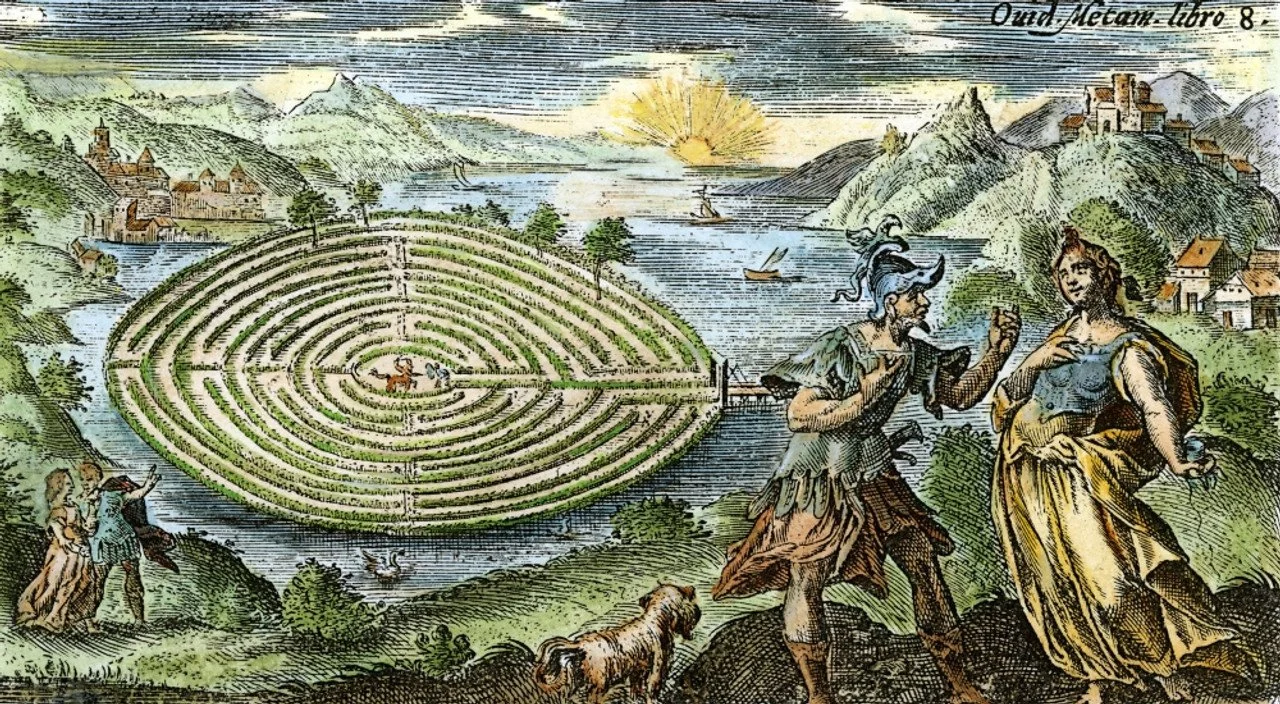
Theseus obtains the golden thread by Ariadne, so that he can enter the labyrinth, confront the minothaur and find his way back.
-What is your golden thread?
The predicament we find ourselves in:
We live in a world with more possibilities than ever, but at the same time there is an acute sense of not knowing where to go. We feel what Heidegger termed “thrownness”, the sense that we have been involuntarily thrown into a world. In our case a world inhabited by the tombstones of the legacy religions, the fading spirit of modernity and postmodernity in its fullest unfolding.
The dualistic metaphysics of a strictly materialist interpretation of science provides a framing in which our subjective experience is cut off from the “real” world of objective facts, thereby alienating us from our own sense of agency as active participants in life.
Meanwhile, the relativistic tendencies within postmodern thought can give rise to the feeling that the ground beneath our feet is indeed groundless. Because if every perspective is relative, we lack the sense of shared truth as a north star, thus knowing how to orient becomes increasingly difficult. Although materialist science has achieved tremendous progress in describing and shaping the world, and postmodern critiques have revealed how knowledge and truth are influenced by perspective and language, I believe we are now called to move beyond both. Because caught between them, we risk experiencing ourselves as simultaneously determined and ungrounded.
On a practical level this means we hold many things at once, but lack the ability to integrate them into a coherent whole. Be it spiritual beliefs, lovers or jobs we jump between them without finding our home in any of them. This leaves us restless and empty, wondering how we can find our place in the unfolding story of life.
The legacy religions had once given us a map on how to relate to the cosmos, but through distrust in their institutions and them not being able to hold up the scrutiny of our (post)modern argus eyes, going back is not an option for many.
This leaves us to our own devices, but while still unable to bridge the gap between subjectivity and objectivity, we keep spinning around ourselves, getting lost in endless games figuring out our own identity.
In the last century this played out on the collective level, by giving rise to the totalising pseudo religious ideologies committing atrocities beyond comprehension.
In our century we are concerned with painting our individual identity with political ideologies, sentiments, hobbies etc. but really, they form a thin veneer covering our sense of not knowing who we are.
Not wanting to gaze into the abyss in the centre of our being, we double down on our masquerade by engaging in escapism and memetic warfare.
Integrity instead of identity as a way forward:
I therefore believe that in order to fill the lingering sense of meaninglessness, we need a form of personal and collective meaning that is not built on shared identity, but on personal and relational integrity. Experiencing ourselves as active participants in an unfolding story can form the basis for such meaning.
To achieve this, we need places in which we can shift focusing from identity towards integrity, places that help us see through the transience of what we are, by showing us who we could become in relation to something bigger than ourselves. I understand myth not as fiction, but as symbolic maps of the psyche, as the stories we live from, through and towards, connecting us to something bigger than ourselves.
By engaging in myth creation is to integrate the many parts within us and bring these integrated wholes into relation with our social and natural environment.
The vision for the centre of (trans)personal myth living aims to create a space, where this is possible, supported by embodied exploration, storytelling and shared practises. A liminal space in which the many patterns constituting the organisation of a personality can first reveal themselves, then begin speaking to each other, to end up forming a dynamic coherent whole that is coupled to something greater than itself.
The liminality could also be described as a place where people are mythologically speaking cast into the underworld, into the unknown, revealing the shifting structures on which the known is built.
The underworld is the place where our personal stories are beginning to speak to our collective stories. By engaging with our personal stories and then mapping them onto our collective stories and vice versa, we can become personal participants in a transpersonal unfolding.
Of course, this begs the question what the nature of this transpersonal story is, and who gets to tell its story.
That is a tricky question, for in some sense everyone gets to write and live the collective story but also, no one really.
The collective story is the domain of the unconscious and is ultimately a mystery that one can relate to, but not explain.
In practice I envision this
Once the story of a person or group has entered into relationship to the collective story, they can rise out of the underworld into everyday life again. But what they take with them, or to be more precise; what they are inextricably bound up in, is a story animating the relation between their subjectivity and what they are emedded in, allowing them to heed their newfound call.
I like to envision the centre for (trans)personal myth living, as a bridge between the profane and the profound, allowing people to travel between their broader culture and the wilderness of our own nature.
